Island
Realty Group is a
full-service real estate
brokerage dedicated to
finding you that perfect
shore property. We serve
the entire South Jersey
Shore Area from
Brigantine to the
Wildwoods plus mainland
Somers Point.
Now more
than ever is the best
time to consider
realizing that dream of
owning a property at the
shore. Our professional
sales team is standing
by!
because
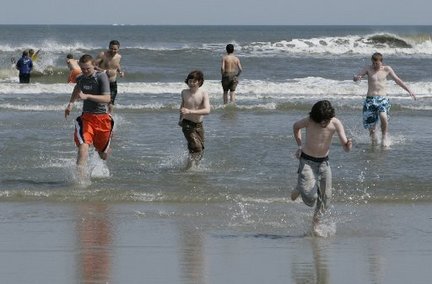
Wildwood has big,
beautiful beaches that
are FREE, beach
concerts, a great
boardwalk
with all the amusements,
shopping, rides, roller
coasters, games,
miniature golf,
boardwalk food for all,
pizza, ice cream, french
fries, deep sea fishing,
charter boats, sea-doo
rentals, sailing,
magnificent sunsets at
Sunset Lake, great
restaurants
an exciting
nightlife, parades, car
shows, Hot rods, Irish
weekends, Harley
weekend, Fireman's
weekend,
Hereford Lighthouse,
Doo-Wop museum,
Convention Center,
Pacific Avenue shopping,
a full calendar of
events,
nearby attractions -
Cape May County zoo,
historic and quaint Cape
May, ferry to Lewes, DE,
Atlantic City casinos,
Stone Harbor shopping,
village of Cold Spring,
and so much more
Wildwood named N.J.'s best beach for third
time in the last four yearsCourtesy
of The Associated Press
Posted May 26, 2011
WILDWOOD — Need more proof that New Jerseyans hate
having to pay for beach badges?
For the third time in the past four years,
Wildwood — the south Jersey resort town where the beaches are free
and gigantic — has been named the state's best beach.
Wildwood and its two neighbors, Wildwood
Crest and North Wildwood, took top honors in the annual contest run
by the New Jersey Marine Sciences Consortium/New Jersey Sea Grant
and the Richard Stockton College Coastal Research Center as a way of
making people feel more connected to and protective of the state's
127-mile coastline. Residents and tourists voted in an online poll.
The three beaches, which market themselves
as a single entity called The Wildwoods, entered and won the contest
that way, too. Admission to all three beaches is always free, which
accounts for a big part of their appeal.
"They're nice and free, and they're always
clean," said Lynda Jarrett, 59, of Lewisburg, Pa. "I've been coming
here since I was 5 years old. I love everything about Wildwood. This
beach is my medicine; it's what keeps me coming back each year."
Joint marketing also paid off for the
second-place winner, the six municipalities on Long Beach Island.
They placed third last year.
Ocean City, another south Jersey family
resort which won the 2009 contest, came in third this year.
The other winners were, in order of finish:
Sea Isle City; Cape May; Asbury Park; Seaside Heights (which moved
up one spot from last year, possibly due to the absence this year of
Snooki); Island Beach State Park; Cape May Point, and Sandy Hook,
the first time the national recreation area made the top 10.
Cape May County thus took five of the top
10 spots in the contest. The Wildwoods, Ocean City, Sea Isle City,
Cape May and Cape May Point are all part of the state's southernmost
county, where tourism is by far the largest industry.
This year's contest also selected winners
for each of the state's four coastal counties. In Monmouth County,
it was Asbury Park. In Ocean, it was Long Beach Island. Brigantine
won in Atlantic County, and Wildwood, obviously, won in Cape May
County.
The winners were announced at a news
conference in Sandy Hook, where Jon Miller, a coastal expert from
Stevens Institute of Technology, said New Jersey's beaches came
through the winter quite well.
"The beaches are in extremely good
condition," he said. "This winter was relatively mild in terms of
the number of storms that impact the coast. It might be surprising
considering the amount of snow we got."
The three major offseason storms — in
October, right after Christmas and in April — all hit at relatively
low tides and did not have extremely large waves that cause the
worst erosion. As a result, Miller said, the beaches are well built
up and able to withstand a summer pounding.
Wildwood has always been among New Jersey's
most popular beaches. Motorists heading to the beach down the main
drag roll up to a giant sculpture that spells out "Wildwoods" in
15-foot-tall letters on the boardwalk. On the ground in front of it
are 29 brightly painted cement beach balls.
The Wildwoods boast three of the only five
beaches in New Jersey that don't require people to buy beach badges
to get onto the sand and into the water. Maybe it's because they
have to work so hard to get to the surf.
The beaches here are a half-mile from the
boardwalk in many spots, kicking sand in the faces of most other New
Jersey beaches. Due to the prevailing ocean currents and the natural
topography of the coastline, sand that washes away from other
beaches piles up here.
In fact, the walk to the water is so far
that Wildwood once seriously entertained a proposal to let a vendor
offer camel rides to and from the surf before deciding against it.
Wildwood also is a hotbed of '50s doo-wop
culture and is home to many oldies festivals and antique car cruise
nights. The three-town resort says it has the largest concentration
of preserved doo-wop architecture in the country, and last year was
named one of America Online's 10 Architectural Wonders of the United
States. Even the Wawa convenience store and gas station on the main
drag into town is done up in neon colors and angular roof lines.
Wildwood and North Wildwood share a nearly
two-mile boardwalk that has its own in-your-face charm, with the
usual pizza and fudge shops alongside T-shirt shacks and body
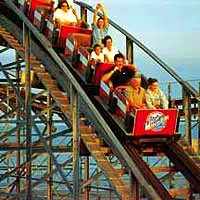
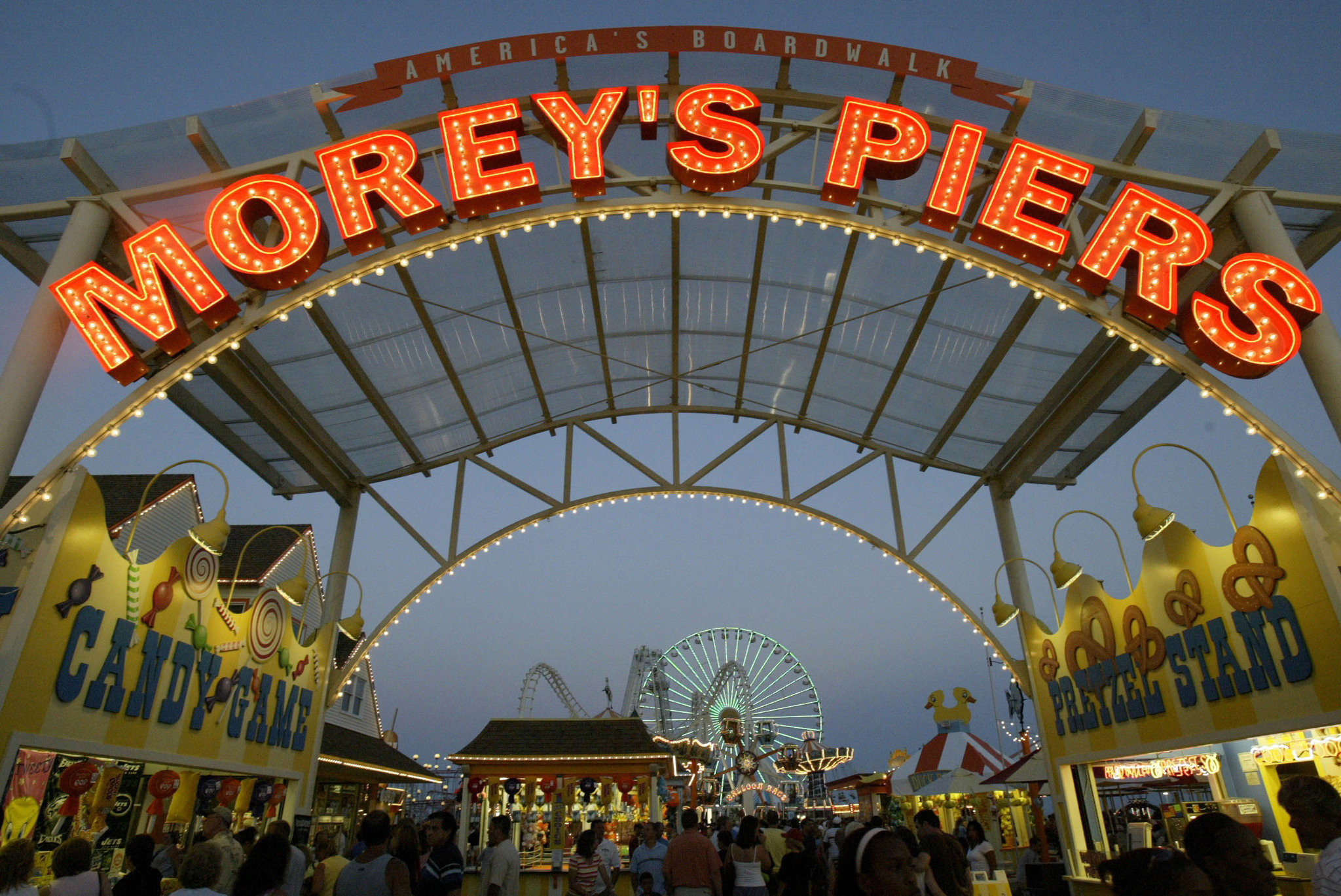
piercing outlets. It has three amusement piers with a gargantuan
roller coaster and a freakishly tall Ferris wheel.
"This is where I've been coming all my
life," said Joan Daug of Waterford, N.J., who was visiting the
resort with her husband, Andy. "I always thought it was a nice
family place. That's why I liked it."
"There's car
shows on the boardwalk, fireworks," Andy Daug added. "There's always
something going on here."
Posted on Sat, May 14, 2011
At Morey's Surfside Pier, new It ride seeks to offer
'maximum fear' and zing
May 10, 2011|By
Jacqueline L. Urgo, Inquirer Staff Writer
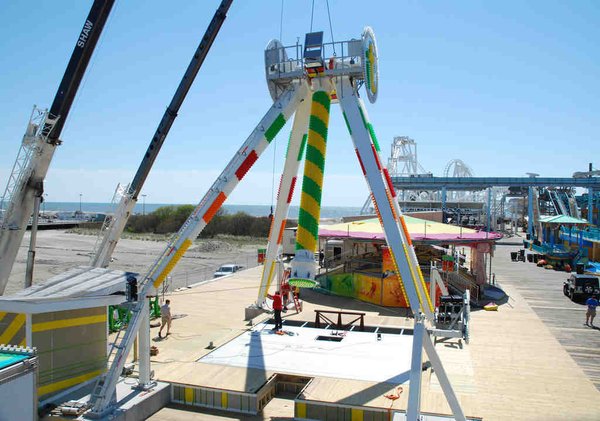
NORTH WILDWOOD - When a
new, $1.5 million, pendulum-style ride known simply as "It"
officially opens on Memorial Day weekend at Morey's Surfside
Pier, it will be the culmination of more than two years of
designing, manufacturing, and installation.
Probably no one understands the
gestational process of a Shore amusement attraction better
than brothers Will and Jack Morey, whose company, Morey's
Piers, operates three locations - Surfside Pier and two
water-amusement parks - on the North Wildwood and Wildwood
boardwalks with more than100
rides, games, and attractions. Their father, Will, and
uncle, Bill, started the business in 1969 with a giant slide
called Wipeout in Wildwood, and added rides annually through
the 1970s and 1980s.
By the 1990s, the younger set of brothers
was running the show and adding attractions. Last year,
Morey's Piers was voted the third-best seaside amusement
park in the world by Amusement Today, a trade publication.
Many other Shore
amusement areas, including the Steel Pier in Atlantic City
and Gillian's Wonderland Pier in Ocean City, also are
family-owned. Operators are constantly updating and
upgrading their offerings, competing to attract new
customers and bring back old ones.
"Inspiration for an
attraction can come from just about anywhere," said Jack
Morey, executive vice president of Morey's Piers, who
travels to carnivals and festivals the world over to keep up
with the industry trends.
A few summers ago, the Moreys decided
they needed to pep up Surfside Pier, their property at 26th
Street and the boardwalk. The place has a "personality" that
Morey says leans toward "seaside carnival, you know, sort of
still wanting to be tacky and proud of it."
He started to
formulate ideas for the new long-armed attraction.
He wanted it loud, with bright lights. He
wanted it tall. (The ride's moving parts swing and hurl
riders six stories into the air.) And he wanted it to have a
relatively small footprint to preserve space for an $11
million wooden rollercoaster coming to the park next summer,
Morey said.
At an amusement
owner's convention, Morey signed a contract with KMG, a
Dutch ride manufacturer, to purchase a version of an
attraction the company called the "Afterburner." Morey spent
months working with designers in the Netherlands to give the
ride the zing Surfside Pier deserved, including a dazzling a
green-and-yellow light package.
They also devised a unique lap-bar system
to provide greater freedom of movement to riders in three
eight-passenger gondolas as they are spun and hurled in a
120-degree swinging motion 65 feet in the air, Morey said.
Normally, an attraction of this type would have a classic
shoulder restraint.
The result is "amazing," Morey said.
"There's minimum confinement . . . and maximum fear in
this one."
Achieving that
balance is where "the art and science of amusement-ride
designing comes in," Morey said. "The art is making a scary,
thrilling ride and the science is in making sure the
passengers are safe but they are unaware of the safety. That
would take the thrill out of it."
Once KMG manufactured the heavy steel
ride, It was packed up and transported to the United States
in two container ship shipments that arrived in New York
about two months ago. The large pieces were trucked to
Wildwood, where about a dozen Morey's employees and KMG
experts assembled them like a giant jigsaw puzzle using
cranes, lifts, and other heavy equipment. Installation cost
an additional $750,000.
Now that It is in place, Morey's will
stage a "soft" opening of the amusement the weekend before
Memorial Day weekend, following safety checks and a final
inspection by state officials. It will officially open on
May 27.
Posted on May 5, 2011
Morey's Piers: Bigger, Better,
Faster
By Amanda Simmons
Noah K. Murray/Inside Jersey
The sun’s shining, the rides are roaring,
the families are laughing. It’s another summer at Morey’s
Piers in Wildwood. And if it all seems just a little bit
in-your-face, that’s because it is.
“We’re tacky and proud of it,” boasts
Jack Morey, executive vice president of the Morey
Organization, which he and his older brother, Will,
inherited from their father, Will Morey Sr.
On a typical summer day, roller coaster
rails swoop around countless boardwalk games and refreshment
stands, filling every nook and cranny of the Moreys’ three
bustling seaside piers.
It’s been going on since 1969, but this
year there’s a bit more anticipation because the brothers
are closer to beginning construction of their largest
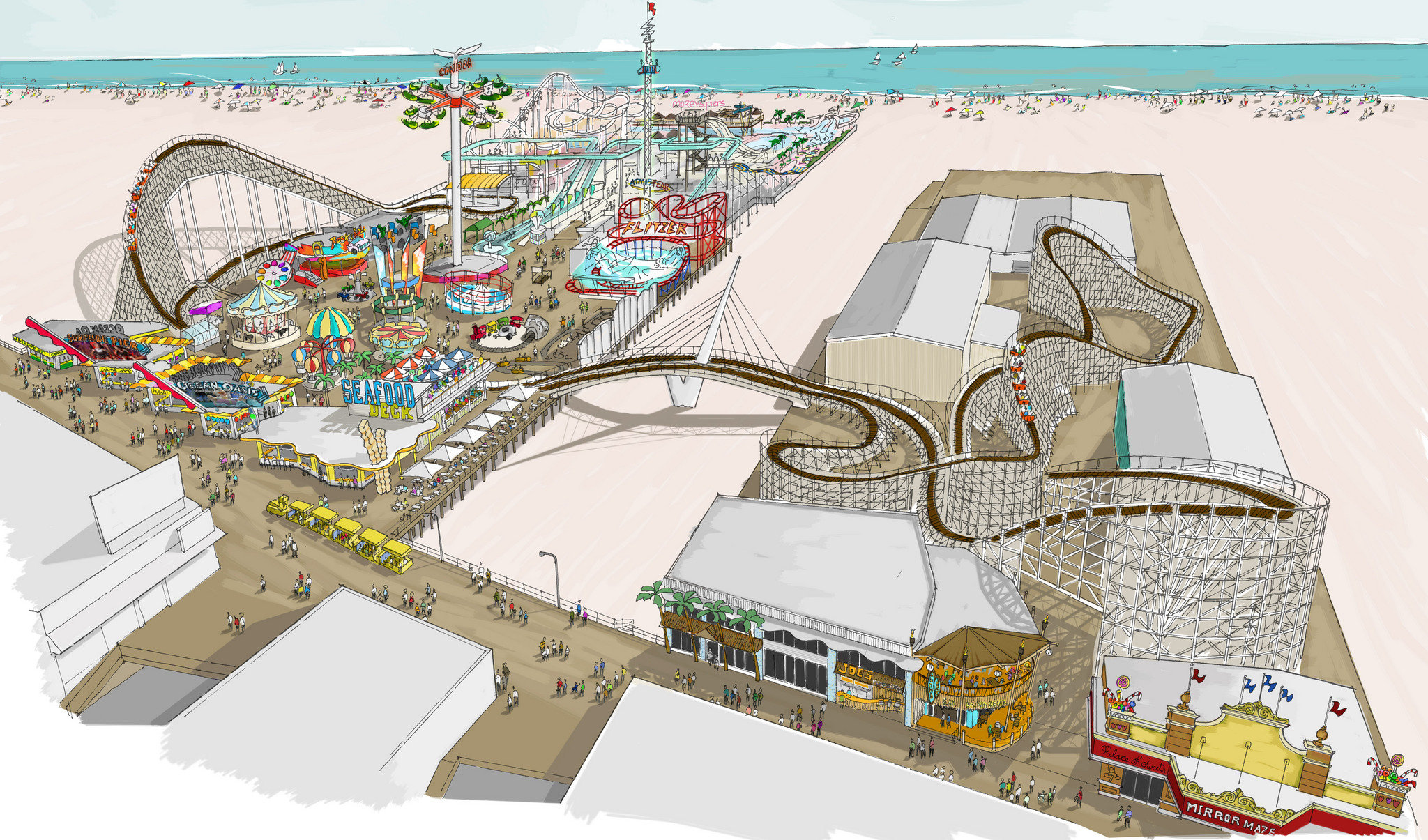
attraction ever: a $10 million wooden roller coaster that
will dive under the boardwalk and stretch out to bridge
together two of the piers — a first in the realm of seaside
attractions.
The yet-unnamed ride, which because of
its size and intricacy won’t be completed until 2013, is
Morey’s Piers’ largest investment to date. Even more
expensive than last year’s new attraction, the $3 million
haunted Ghost Ship.
“We invest more than anyone else,” says
Jack. “Some would say that we’re a little reckless and we
over-invest. And that might be true. But that’s how we’ve
gotten here.”
To make room for the new thrill ride,
they had to demolish the amusement that started it all, a
giant slide called Wipe Out, built by their father, who died
in 1998. However, the brothers agreed that sometimes you
have to cut your ties to the past to keep pace with the
present.
“Operationally, it (Wipe Out) just didn’t
work for us anymore. There are so many changes, and people’s
interests are less flexible these days,” says Will,
president of the company. Ridership had declined greatly
since the amusement’s heyday.
And although Jack praises his brother’s
rarely faltering business sense, even Will saw the closing
of their father’s slide as bittersweet.
“It’s an artifact of our history,” he
says. “It’s hard to move something that represents where it
all began.”
View full size
Courtesy of Morey's Piers
Plans for the new roller coaster at Morey's Piers, set
to open in 2013.
The Morey family adventure started when
Will Sr. and his younger brother, Bill, took a trip to
Florida in 1968. There, according to family lore, the
brothers came upon a giant fiberglass slide in a parking lot
and loved it so much Will Sr. decided to re-create it back
home.
The brothers bought two plots of land in
North Wildwood, between 25th and 26th streets, and
constructed a similar amusement on their new slice of
boardwalk real estate. In the summer of 1969, Wipe Out
opened on what is now Surfside Pier. The success of a single
ride led to rapid expansion and an unexpectedly booming
business.
It’s been 42 years since that
inauspicious beginning, and Morey’s Piers has essentially
become the preeminent boardwalk player. Gone are the days of
simple, old-school rides like the Moon Bounce, Scrambler and
Zipper. It was only a matter of time for Wipe Out.
Jack, often labeled as the creative half
of the sibling pair, says business — and exciting new
opportunities — dictated the closing of their father’s
slide.
“Our No. 1 consumers are kids, and kids
don’t really care about nostalgia,” he says. But that
doesn’t mean all tradition is fleeting on the Wildwood
boardwalk. The Moreys don’t want to squander their resources
by pouring money into antiquated rides, but they do want
their pricey investments to last. “We need to build things
that can be timeless,” says Jack.
And that’s where the new coaster comes
into play. An attraction of its kind hasn’t been erected on
the boardwalk in some 100 years, according to the brothers.
So while it may be innovative, it will retain certain
classical elements as well as the historic culture of the
Morey family and the doo-wop Wildwood scene.
“More than anything, we’re trying to be
an authentic seaside playground for the whole family; that
diversity (on the boardwalk) is so unique and has an
authenticity we think is strong and that we want to
continue,” says Will.
“Ultimately you have to know your
potential,” says Jack. “I think our potential’s great, but
we’re not a 24-hour place and we’re not a 12-month place. So
we try to give people something very special that they can’t
have at home.”
Such as the $3 million haunted Ghost
Ship, a 15,000-square-foot, interactive, 11-minute
walk-through fright fest, featuring advanced technical
theatrics and up to 20 live actors. Since it opened last
year, several adjustments have been made to add intensity to
the experience. With technicians and actors customizing each
run-through, no two “tours” through the ship are alike.
With such one-of-a-kind attractions, the
brothers say, Morey’s can continue to build on its success.
And their long track record appears to support the claim.
In the 1920s, there were more than 1,500
seaside amusement parks in the United States. But as time
went on and technology advanced, the boardwalk amusement
industry began to dwindle; today only about 30 remain.
While amusement parks such as Legoland
and Universal Studios require pay for mere entry, Morey’s
Piers make use of what it has: open, oceanfront space.
“We’re one big giant public space. We’re
not trying to be a fantasy land. We believe strongly in the
desire for families to interact, and that’s a huge
foundation upon which we’re trying to carry the business
forward,” says Jack.
He and Will say they’ve been able to
craft their own unique and understated brand that seemingly
manages to organize the chaos of Wildwood’s archetypical
Jersey Shore boardwalk.
“We don’t like the word ‘theme’ because
we’re not a theme park. But there is some classic seaside
element that’s at play,” says Jack. “We continually want to
provide a sensory overload that is very public in its
nature.”
It’s a premise that has worked for the
Moreys, even as similarly styled parks have failed, because
they have been able to reinvent their business without
losing sight of their community’s historic spirit.
In January 2009, the Morey brothers had
to say goodbye to the Golden Nugget — a classic
mining-themed coaster that had been the last vestige of the
legendary Hunt’s Pier (which the Morey Organization acquired
in 2000).
The ride was built in the ’60s, and the
Moreys held onto it in hopes of restoring it — a renovation
that proved too costly. So the organization held a farewell
ceremony on Jan. 31, 2009, well-attended by passionate
boardwalk enthusiasts even though the rest of the park was
closed for winter.
“One thousand people standing outside in
frigid, frigid temperatures. It was pretty remarkable,” says
Jack.
Since last summer, the brothers have been
trying to decide on a name for their new roller coaster.
Jack likes the name “Wildwoody.” Will prefers “Boardwalk
Flyer.”
Whatever they decide, Jack and Will can’t
imagine that even this massive project will be their last.
“I hope it will never be done,” Jack says of the piers.
In fact, no season would be complete
without a new ride. And this year is no exception. This
month, the brothers introduce “it,” a ride that combines a
swinging motion up to 120 degrees and a rotating center with
facing gondolas.
“We’re in the reshaping business,”
says Jack. “You never know what’s around the corner.”
Posted on Sun, Aug. 8, 2010
Kevin Riordan: Skee-Ball: Forever on a roll
In boardwalk arcades, going
for the "50" seems an eternal
pursuit.
A Shore retreat for four generations By Jen A. Miller
For The Inquirer
WILDWOOD CREST - Jack Callahan doesn't have air-conditioning. He doesn't want it, either, even as he sits on the front porch of his house on a hot, humid summer day in long pants and a button-up shirt.
"We've never had air-conditioning as long as I've lived here," Callahan says. "At night, we get a beautiful breeze from the ocean or the bay."
He's used to it, and it's hard to see why not. He's lived in this house in Wildwood Crest for 60 years. But it's a far cry from the small beach cottage he bought right after he married.
Today, it's a 2,200-square-foot, two-story beach retreat that is the weekend gathering spot for the Callahan clan, whose members live in the Philadelphia suburbs on both sides of the Delaware and who, on this particular summer day, took up every available space and room in the house.
And that was before adding in grandson Shane Whipkey's club lacrosse team, still asleep upstairs before playing a tournament on the beach.
"I have 10 to 15 people down every weekend," says Callahan, who lives at the Shore year-round with his son Tim.
The house, built in 1910, was one of the first on the Crest. It was a small bungalow perfect for Callahan, now 86, and his bride, Elizabeth.
"She was working at the Acme as a checker, and I was buying food," he says of how they met in Germantown.
Elizabeth was from Wildwood Crest, so when they married, they honeymooned there and stayed. His wife passed away in 2004.
"When we first moved here, a train ran down the street, and the ocean was only two blocks away," he says. The neighboring property was a custard stand, then a Wawa, and is now a private home.
The couple had four children, which led to six grandchildren and six great-grandchildren. Most of them come down every weekend.
No one can quite remember how many renovations they've done on the house because there have been so many. A large addition was put on in 1964 to make room for the children. A front porch was built. The siding went from diamond asbestos to square asbestos, and is now vinyl. The downstairs kitchen was moved three times.
One of the former kitchen spaces is now a sunroom at the front of the house. An upstairs addition with a kitchen was built, and then the stove was removed when Callahan realized too much space was being occupied by things that weren't being used.
Two of Callahan's children passed away as a result of the Vietnam War, one in combat and the other from injuries sustained during the war. He keeps a memorial in one corner of the downstairs living room.
The Beschen-Callahan Memorial Lifeguard Races, held in Wildwood Crest for 42 years and considered the oldest continuous lifeguard races in the country, are held in their honor. Shane Whipkey is on the Wildwood Crest squad.
Jack still works - he's owned Callahan Roofing since 1956 - and his office in the home's basement looks as if it could belong to any twenty- or thirtysomething.
Standing out from the papers, filing cabinets, and phones (land line and cell) is a new iMac. He knows how to e-mail and upload videos to YouTube. It's crucial to keeping up with his children and grandchildren, he says.
His favorite spaces are outside the house, though.
What was once just a backyard, where youngsters played in space shaded by a tarp, is now "Jack's Shack." The playing still happens, but now there's an annual family talent show, complete with a DJ (grandson Patrick Whipkey of Bellmawr).
Before the talent show, Catholic Mass is said in the backyard. On those special occasions, the house makes room for 20-plus.
An outdoor covered porch functions as another gathering area.
"We eat here every night," Callahan says, especially in the summer, with a table long enough for all his visitors and an outdoor refrigerator stocked with ice-cold beer.
Callahan is sitting at that outdoor table, with his children, their spouses, and his grandchildren interjecting and adding stories and memories about the house, when the lacrosse team finally wakes up and comes downstairs.
The players stop at the beer fridge or give Callahan a firm pat on the back. He asks them whether they met any pretty girls the night before.
"The young kids make my life," he says.
There are still a few to-do projects for the house, Callahan says, including new carpet that's being installed on the first floor, and a dozen or so smaller items.
But the list does not include central air-conditioning.
Callahan says he'll never move.
"I'm going to be laid out in that front room."
Posted on
Sun, Aug. 8,
2010
Kevin Riordan: Skee-Ball:
Forever on a roll
In boardwalk arcades, going for the "50"
seems an eternal pursuit.
By Kevin Riordan ,Inquirer Columnist
WILDWOOD -
Flat-screen TVs make fabulous prizes,
but boardwalk arcade-game players prefer
something plush. "Stuffed animals," says
Mike Weimar, games manager of the three
Morey's amusement piers in Wildwood.
"People want plush. They love plush."
For a columnist on a quest to find out
what has (and hasn't) changed in the
world of summer fun and games, there's
no better destination than Wildwood,
where retro never goes out of style.
From behind a merry fringe of multihued
beach umbrellas in the distance, a
peerless ocean breeze cuts through the
curtain of August heat on the boardwalk,
where I explore the timeless appeal of
tossing a ball, throwing a dart, and
pitching a quarter.
"It's the thrill of winning," longtime
Morey's game operator Mike Horant
explains. "The thrill of winning
something."
This summer, you can win iPads and
Phillies gear and stuffed versions of
Jorge, Stewart, and Dave, the "minion"
characters from the animated movie
Despicable Me.
Their goofy, goggled faces are
everywhere in the boisterous carnival of
this proudly blue-collar boardwalk.
Amid the pizza stands and taffy counters
and shops hawking teeny-weeny tops and
even teenier shorts, electronic,
mechanical, and physical skill games
beckon with state of-the-art flash,
old-fashioned come-ons - and the chance
to take home your very own Shrek doll.
"It's like going to Atlantic City,
except you win," says Jeff Verzella,
manager of the arcade at Mariner's Pier.
Those spinning prize wheels of the '60s
and '70s that offered winners their
choice of a vinyl record album have
disappeared (alas).
Cartons of cigarettes are no longer
prizes, either. At one time, this would
have struck me as a tragic loss; now,
not so much.
But the mother of all seaside games is
alive and well and racking up points.
You guessed it: Skee-Ball.
Back when sailors were the only tattooed
people on boardwalks, before anyone was
inspired to deep-fry an Oreo, before
there even were Oreos, a Philadelphian
named J.D. Estes came up with a clever
combination of bowling and pinball.
That was in 1909. Since then, "we've
made a few changes, but basically, it's
the same game," says Eileen Graham,
director of marketing for Skee-Ball Inc.
in Chalfont, Bucks County.
At the Mariner's Arcade, where there are
17 Skee-Ball machines, the playing
rarely stops.
"He loves it. He's nuts about it," says
North Cape May resident Jovita Castner,
referring to her 48-year-old son, Steve.
"He's a special [needs] person, and we
come at least once a week. He plays
until he's exhausted," says Castner, 72,
who grew up playing Skee-Ball and only
stopped because of her arthritis.
The Fusiks, of Hamilton Township, Mercer
County, are multigenerational Skee-Ball
enthusiasts, too.
"We have a family competition," Melissa
Fusik says of her six kids and her
husband, Bob.
Mike Myers, who's 15 and from Pittsgrove,
has played Skee-Ball for three years.
"It's addicting," he says. "You can't
stop."
Myers averages about 9,000 points per
visit to the arcade and so far this
summer has accumulated 76,000. Each game
costs a quarter, still. "I'm trying to
save up 260,000 for an iPod Touch," he
says.
Prizes have evolved, "but plush still
comes out on top," Weimar says.
Even at the Blockbuster game stand,
where folks step right up to throw a
beanbag at a stack of blocks (top prize,
a flat-screen TV), a big stuffed pink
gorilla "is a draw," he says. "People
have their picture taken with him."
Like plush prizes, Skee-Ball has endured
while fads have come and gone.
You can even play Skee-Ball via an
iPhone app.
But it doesn't come with an ocean
breeze. At least, not yet.
Posted on Sun, Apr. 26, 2009
Seeing Potential by the
Sea
Mary Jane Malandrucco saw
the ocean view; her husband, Greg, saw a
great deal of work.
By Jen A.
Miller for The Inquirer
Ask Sam Malandrucco, 3,
what he likes to do at the Shore, and he
shrugs.
"I dunno,"
he says and goes back to pushing a toy
bus full of animals across the hardwood
floor of his family's North Wildwood
condo.
Mary Jane Malandrucco
insists that is not so, and as his
mother talks about playing in the ocean,
digging in the sand, and riding bikes,
Sam gives a wide smile, then tumbles
playfully across the floor.
Sam was still a baby
in 2007 when Malandrucco came back from
a girls' weekend at the Shore that
included making a bid on a condo -
without telling her husband, Greg.
"Instead of trying to
talk him into things, it works better if
he tries to talk me out of it," said
Mary Jane Malandrucco, 47, a sales rep
for Element K, an e-learning company.
Greg Malandrucco could
have made a good case against buying
this condo. The two-bedroom, two-bath
unit, built in the early 1980s, was in
poor shape.
"I was apprehensive,
to say the least," said Greg Malandrucco,
49, an IT manager for the Tredyffrin/Easttown
School District in Chester County. "All
I could see was work, and all Mary Jane
could see was the beach."
Ocean views helped
sell him on the place. So did the
garage, which he would use for staging
his renovation work - taking out and
replacing everything except the smoke
detector and the carbon monoxide alarm
on the way to creating a cozy vacation
home.
The couple, whose
primary home is in West Chester, bonded
over a renovation project when they met
22 years ago. Mary Jane Malandrucco
tried to repaint the kitchen of her Mays
Landing condo soon after she met her
future husband. It did not exactly turn
out as planned, so Greg Malandrucco
offered to redo it.
"That bad paint job
led to a new kitchen," she said.
Together, the couple,
who married in 2000, have bought, fixed
up, and eventually sold homes in
Chesterbrook and Sicklerville. Greg
Malandrucco, who learned about repairs
while working at his father's deli, did
most of the home improvements himself,
building on those skills (and buying
tools, he says) with every project.
Both liked the Shore.
Mary Jane Malandrucco, who grew up in
Pottstown, worked in Stone Harbor during
summers as a college student; Greg
Malandrucco, who grew up in West
Philadelphia and Havertown, spent two
weeks in Wildwood with his family every
year.
"I always thought that
I'd eventually buy something at the
Shore," Mary Jane Malandrucco said.
So she kept her eyes
open. Still, she acknowledged, when she
saw the listing for the North Wildwood
condo in the newspaper, "the pictures
were so awful."
The condo had not been
updated since the building was
constructed in the 1980s. It still had
wood paneling, shag carpet, and dated
wallpaper in the kitchen.
"But the ocean view
kept me looking," Mary Jane Malandrucco
said - you can see the sea from the
living room, kitchen, and bedrooms. She
toured the place on that weekend away
with her friends and put in the offer.
The couple bought the
place and, swayed by Mary Jane
Malandrucco's vision, Greg Malandrucco
went to work, taking on projects at the
condo between the freelance jobs he was
doing then.
He started in the
kitchen, taking everything down to the
studs. He kept the basic floor plan, but
changed the cabinet layout a bit and
substituted an island for the
wrought-iron railing that separated the
kitchen from the sunken living room.
They put seating on
both sides - regular chairs in the
kitchen, bar stools in the living room -
so the island could be used for dining,
which freed up space.
Then Greg Malandrucco
ripped up all the rugs - no small feat
considering that the previous owner
carpeted just about everything,
including the bathrooms and on top of
the half-inch molding in every room of
the house.
The Malandruccos
replaced the floors with hardwood,
except for tile in the kitchen and
bathrooms. They added white wainscoting
to the bathrooms, too, and a walk-in
shower to the master bath.
A fireplace in the
living room was covered with faux-brick
wallpaper. Greg Malandrucco redid the
tile, hearth, and mantel.
Out went floral
wallpaper and wood paneling. In came
drywall, so the walls could be repainted
in cool, beachy blues and greens. Greg
Malandrucco also added white trim and
molding throughout the house and wired
the ceilings for surround-sound speakers
and a fan in the living room.
The laundry area was
reconfigured for a full-size stacked
washer and dryer.
Sam's bedroom has
special bunk beds - a twin on top and a
full-size bed on the bottom - for guests
and sleepovers.
"This is my big-boy
bed," he said, proudly jumping on the
bottom bunk. His playpen now holds his
toys.
Mary Jane Malandrucco
confesses that her husband is the one
with the handyman skills. She just picks
out the properties and envisions what a
space could be.
"Greg and I have
always been able to see . . .
potential," she said.
There were
complications, naturally, like the water
damage they found around the living
room's sliding glass door. The
refrigerator caught fire, so they lived
out of a cooler until a new one arrived,
sooner than expected.
Not that their son
minded.
"Sam liked playing in
the refrigerator box," Mary Jane
Malandrucco said.
Shore Thing: The
Jersey Coast
offers
summertime
values
Want more proof
the Hamptons may
be passe? While
Long Island
summer share and
house rentals
continue to drop
in cost, rental
prices on the
Jersey Shore
this year
haven’t
decreased. But
that doesn’t
mean the Jersey
coastline is
immune from the
economic crisis,
or that good
deals can’t be
found.
“We have fewer
people renting
for the full
season and more
weekly rentals,”
says
Mary Holder,
broker/owner of
Better Homes and
Gardens
Real Estate Mary
Holder. “Tenants
are splitting
their vacation
time midwinter
and are coming
down to the
shore for less
time.”
Holder’s agency,
which serves
Monmouth and
Ocean counties,
has experienced
a decline of
Wall Street
tenants and a
lower inventory
since homeowners
are utilizing
their own summer
properties. Not
surprisingly,
some homeowners
are attempting
to sell their
second homes.
Despite the
times, the
summer rental
market along the
Jersey Shore
remains active
since each town
caters to
different
lifestyles. If
you’re looking
for a deal this
summer, try
these towns.
The Wildwoods
Free beaches and
amusement parks
keep Wildwood
popular among
the
MTV
generation.
Spanning two
miles and 38
blocks, the
town’s
old-fashioned
boardwalk
features a wide
range of arcade
and
carnival-style
games, water
parks,
world-class
roller coasters,
souvenir shops
and eateries.
Although this
town is very
family-oriented,
it also boasts a
great nightlife
for singles and
couples with
trendy
nightclubs like
the Stardust
Club and Echo’s
and Irish pubs
like the
Shamrock Cafe
and Westy’s
Irish Pub.
There is a large
selection of
rental
properties which
can be viewed at
www.WildwoodRents.com
.
Local Cops Hit the
Jackpot!
By Ted Greenberg
NBCPhiladelphia.com
updated
1:18
p.m. ET,
Tues., April 21, 2009
They didn’t become mega-millionaires. But at the
Wildwood Crest Police Department, nobody is
complaining about the quarter-million dollars
that suddenly rolled in.
“Took me a few good hours to believe what was
being told to me,” said Detective Ed Gorski, one
of 14 members of the force who each threw in $5
for tickets in the February 27 Mega Millions
drawing. The jackpot that night was worth $171
million.
The group had all the winning numbers except the
Mega Ball, which delivered them a $250,000
prize. That equals about $13,000 each, after
taxes.
“I was surprised. I certainly never thought I
would be part of any winnings of the lottery,”
Patrolman Robert Lloyd told NBC10 News Friday.
One of the department’s sergeants bought the
ticket at the Crest Tavern in nearby Lower
Township, but nobody realized it was worth so
much until weeks later, when the bar put up a
sign advertising that it had sold a winning
ticket.
“(The sergeant) told us on April 1st so I
thought it was an April fools joke, but it
turned out it was true,” Lloyd recalled.
So what are they going to do with the cash?
“Pay off some bills, put some away. I’m getting
married next month, so that’ll help out,” Lloyd
said.
Wildwood meets bathers halfway
By TRUDI GILFILLIAN Staff Writer, (609) 463-6716
Press of Atlantic City
Published: Friday, June 29, 2007
WILDWOOD — Sure, a moving sidewalk that carries beachgoers and their belongings the
1,800 or so feet between the Boardwalk and the water's edge here
would be perfect.
But visitors such as Diane Dunham are almost as
thrilled with the next best thing — a wooden walk that makes at
least half the trek across the city's expansive beach just a little
easier to manage.
On Thursday, public works crews installed the new
wooden walks at several streets. Most of the wooden sections ordered
by the city should be in place in time for the Fourth of July
holiday.
“You're not having to walk in that hot sand,” said
Dunham, of Woodstown, as she and her friends and family prepared to
make the trip toward the Atlantic Ocean from the Boardwalk at
Leaming Avenue.
They came to town for the day, but with what
appeared to be provisions for a much longer stay. There were beach
chairs, a cooler, buckets and shovels, beach towels and more. The
little ones in her group helped carry what they could, and the new
wooden walk eased their burden, too.
The wooden walkways,
made of pressure-treated pine, were built through a Department of
Corrections program and funded by an $80,000 grant from Cape May
County, said city development director Lou Ferrara.
Nine hundred of the 4-by-10-foot-long sections
will be planted up and down the beach as they come in. By Thursday
afternoon, Roberts, Rio Grande, Leaming and Hildreth avenues had the
walkways in place.
Mayor Ernie Troiano Jr. said the city hopes to
improve access for everyone, particularly those in wheelchairs, who
want to enjoy the beach. Beach ends with ramps were among the first
to receive the new walkways.
In addition to the 900-foot-long walks, the city
has added portable toilets at the end of the walks, including
handicapped-accessible facilities, said acting Public Works Director
Kevin Verity.
Along the way, extra boards have been added at
certain points to allow room for beach- goers to pass each other.
Benches will likely be added later, Troiano said.
Ferrara said the boards will likely stay in place
until the season comes to a close, and then they will be stored
until next summer.
And in the meantime, the mayor warned those with
permits to drive on the beach not to drive across the walkways,
which could crack or break under the weight of a car or truck.
“Anybody caught driving over them will be shot at
sundown,” the mayor joked.
Construction Underway for Luxury
Jersey Shore Condo Complex
June 08, 2007
Commercial Property News USA
By Amanda Marsh, Associate Editor
The Grand at Diamond Beach condominium complex in Diamond Beach,
N.J., is well on its way. The property, which is just south of
Wildwood in Cape May County, is a 12-story building that will
contain 125 upscale condo units along with associate amenities and
recreation areas upon its completion, expected in fall 2008. The
site is the former location of the Grand Hotel, which was razed to
make room for the development.
The Dick Corp. was recently awarded a $100 million contract to
provide construction services for the project along with Baumgardner
Construction. Paul Chiolo, the sales director for the project and
the owner of Oceanside Realty, which is marketing the condo units,
told CPN the total build-out would be in the "couple hundred million
dollar" range.
The Grand at Diamond Beach is an unprecedented project for the Cape
May area. "This is the only condo/lifestyle project of its type on
the Jersey Shore," Chiodo said. The project is in response to the
growing affluence of the area, and is unique because of its private
beach. The parcel next door, which is currently home to the Pier
6600 Motor Inn, will house the second phase of The Grand at Diamond
Beach a few years down the line, he added. The second phase is
currently in its design stage by the project's developer,
Achristavest L.L.C., which specifically focuses on waterfront
residential developments.
Other upscale residential projects Achristavest currently has under
development include: Shoals Resort in Bald Head Island, N.C.; Santa
Rosa in Ocean City, N.J.; and Deerfield Estate in Deer Valley, Park
City, Utah.
By PETE McALEER Statehouse Bureau, (609) 292-4935
Published: Saturday, June 2, 2007
TRENTON — When the state adopted a 7 percent lodging tax in
2002, it cushioned the blow with a promise seemingly backed by
the force of the law.
By statute, the Legislature dedicated a portion of the revenue
from the room tax to tourism and the arts. The win-win scenario
had the state collecting more tax dollars from the lodging
industry but investing more into tourism to attract new
visitors.
Five years later, half of that scenario has held true. Guess
which half.
“The only part of the bill that they enacted is the part about
taking the money,” said Diane Wieland, director of tourism for
Cape May County.
Tax revenue from hotel and motel visits continue to grow each
year, bringing $78 million to this year's budget and a projected
$87 million in the upcoming budget.
Meanwhile, tourism officials are back in Trenton, fighting for
money they thought had been guaranteed. The state cut tourism
funding from $12.76 million to $10.1 million last year and
proposes to spend the same $10.1 million this year.
“The state is reneging on a promise they made,” said Aldo
Tenaglia, owner of the Royal Canadian in Wildwood and Shalimar
Resort in Wildwood Crest.
For hotel and motel owners, the tax puts their businesses at a
disadvantage not only with other states but with their
neighbors, Tenaglia said. Hotels and motels must charge both a 7
percent sales tax and a 7 percent lodging tax. The state does
not collect either tax from condominiums or rental properties.
While hotel and motel owners feel shafted, state treasury
officials are pointing to the fine print. The statute recommends
the state spend $12.7 million on tourism, but it allows for a
minimum appropriation of $9 million, said Treasury Department
Spokesman Mark Perkiss.
“When you look at the statute, it doesn't say ‘you must,'”
Perkiss said. “We're in compliance.”
John Siciliano, executive director of the Wildwood Convention
Center, said the state takes the wrong attitude toward the
tourism industry.
“This is a $47 billion industry for the state, and we're going
to be sitting down arguing over $2 million,” Siciliano said.
“I'm shocked we're even having these conversations.”
Two weeks ago, Assemblyman Jeff Van Drew — who is chairman of
the Tourism and Gaming Committee — held a hearing about the
issue. He plans to rally tourism officials to attend an upcoming
budget hearing and fight for full funding.
“Our argument is we know the budget is tight, but the city of
Philadelphia spends more in tourism promotion than the entire
state of New Jersey,” Van Drew said. “I think as distasteful as
that tax is, the redeeming factor was there would be a statutory
requirement to fund tourism. You really are breaking the intent
and the spirit of the legislation.”
Van Drew said he will introduce legislation that requires the
state to fund tourism fully or eliminate the occupancy tax. He
said the bill will not move in time for this budget, which must
be adopted by July 1.
A similar “poison pill” amendment requires the state to fund
beach replenishment fully if it wants to collect the real estate
transfer tax. Those types of arrangements typically are set
before a tax is adopted and not after.
State Sen. Nicholas Asselta, R-Cape May, Cumberland, Atlantic,
said the Legislature pulled a similar trick when it promised to
direct money from an income tax increase toward property tax
rebates, then later cut the rebates while keeping the tax.
“Where does it end?” Asselta asked. “We should be fighting for
more money, not what's owed to us. This is the livelihood of the
state, tourism, and you're shorting them $2 million in marketing
money. Is this maybe one of the underlying reasons for why we
still have a deficit? It's penny-wise and pound-foolish.”
For Weiland, the director for Cape May County's tourism
department, the biggest concern is that the numbers show a trend
toward daytrippers. She said Cape May County's accommodations
industry has remained flat for three years at $2.2 billion
annually, while revenue for attractions has risen 60 percent.
“If we reduce tourism funding by $2 million, are we doing
everything we need to do?” Weiland asked. “We need to use every
penny of that to expand our market and open new markets to
create overnight stays.”
Statewide, tourism has fallen from the state's second largest
industry to its third, behind pharmaceuticals and technology.
Marilou Halvorsen, president of the New Jersey Travel Industry
Association, said the state's own study shows every dollar spent
on tourism promotion brings back $29 to the economy.
“I don't know any investment on Wall Street that yields that
kind of return,” Halvorsen said.
Jersey shore amusement hotspot ditches paper
tickets
December 12, 2006, 10:00 AM EST
Press of Atlantic City
WILDWOOD, N.J. (AP) _ You aren't going to need a
ticket to ride at one New Jersey shore institution starting next
summer.
Instead, you'll need a plastic card.
Morey's Piers, a string of five seaside
amusement parks, is doing away with its traditional paper
tickets _ long the stuff of scrapbooks and displays at the
Wildwood Historical Society Museum.
For rides from the mini tea cups to the AtmosFEAR, admission
will be paid starting in 2007 with plastic cards that look a lot
like credit cards. That means no more tearing off two or three
tickets per ride.
Will Morey, president of the piers, told the Press of Atlantic
City for Tuesday's editions that he thinks customers will be
comfortable with the switch _ even if nostalgia seekers aren't.
The cards can be reloaded from home computers and registered so
that it will be possible to find the owners of lost ones _ and
to trace the track of kids lost while playing at the pier.
"We're a unique breed," Morey said, "and we don't want to be
outdated."
Published: Thursday, October 12,
2006 Press of Atlantic City
WILDWOOD CREST —
The borough has awarded a $1.8 million contract to Albrecht & Heun
to stabilize the shoreline around Sunset Lake.
Borough Clerk Kevin Yecco said the project
involves the addition of soft-concrete armoring to square off and
clean up the area along the shoreline of the popular lake.
Yecco said the project would allow the borough to
reclaim another 10 to 20 feet of land by removing the rocks and old
concrete dumped in the lake decades ago near Rambler Road south,
making the area more attractive at low tide.
A pre-construction meeting will take place in the
next couple of days to determine a project timeline.
Funding for the shoreline improvements comes from
$1.4 million in state grants with the borough providing the
remainder.
During Wednesday's regular
meeting, Borough Commission also agreed to submit an application to
the state Department of Transportation to use state money set aside
to extend its bike path to instead improve the bike path that
already exists along the beachfront.
The borough has $250,000 set aside to extend the
path, but found it would make more sense to upgrade the existing
path.
During a closed session, the commissioners also
discussed the town's involvement in the Joint Construction Office of
the Wildwoods.
The borough previously submitted a letter to the
island-wide agency informing it of the borough's plans to leave the
joint construction office by Dec. 31 if its requests were not met.
Those requests include hiring a full-time administrator and having
the state conduct any building inspections of high-rises proposed
for the city of Wildwood.
Yecco said the borough is still reviewing its
options while it waits for a formal response from the joint
construction office.
Some of the options under consideration are hiring
a third-party to conduct the borough's building inspections, having
the state Department of Community Affairs perform inspections or
having the work done in-house.
Borough Solicitor Doreen Corino also is working
with Tax Assessor Jason Hesley to come up with a plan of action
regarding Cape May County's order that the borough perform a
revaluation.
The borough has been told to conduct the
revaluation of the town's properties next year to allow those
figures to be placed on the county's tax rolls in 2008.
Also Wednesday, the commission considered whether
its logo, featuring the Brigantine Nancy, should be replaced with
something new. The matter is still in the discussion phase.
NORTH WILDWOOD —
Southern New Jersey's shore and summer vacations were synonymous for
the May family.
“As a kid, my parents used to go down to the
Wildwoods,” Richard May said. “To us, North Wildwood was the shore.”
So as an adult, it seemed fitting that May, 64,
would buy a vacation home here. He hoped his three children and five
grandchildren could create equally lasting memories.
But a cloud overshadowed what should have been a
sun-filled summer at the shore for May and many of his fellow
condominium owners. They found out their properties may not have
been built up to code.
The Joint Construction Office of the Wildwoods,
which oversees construction projects for Wildwood, Wildwood Crest,
North Wildwood and West Wildwood, notified the owners of nearly 500
units primarily in Wildwood and North Wildwood of the possible
violations this year. Most received word in the first few months of
2006, but some, including May, only learned of the problem in June.
Owners were told their buildings
may have been improperly inspected by the construction office or not
built to code, and that an array of violations, such as a lack of
firewalls, had to be repaired.
The construction office, according to its
attorney, Glenn P. Callahan, is also reviewing other buildings, as
many as 2,000, constructed between 2000 and 2005 to determine if the
problem is more widespread. The review will then extend to other
multifamily buildings erected prior to 2000, Callahan said.
The reported deficiencies in May's building, a
four-unit property on Ocean Avenue, include the need for a second
staircase and questions about the very joints holding it together.
Suddenly, May, of Yardley, Pa., found his perfect
vacation home was not so.
May recalled looking at 28 properties in 2003
before he found number 29.
“Something with an ocean view, not the Boardwalk,
and I liked the layout,” May said.
North Wildwood's appeal, he said, included what he
called the gentrification of the island, linked to a changing real
estate market combined with prices still relatively reasonable
compared to neighboring shore towns Avalon and Stone Harbor.
He purchased his unit for under $300,000.
According to the city's recent revaluation, the 1,600-square-foot
unit is now valued at $570,000.
With the code question looming, however, those
figures lose some of their meaning.
“For starters, if I wanted to, I can't sell it. I
can't rent it if I wanted to right now,” May said. “I have no idea
what my property is actually worth.”
And he has only an estimated idea of what it will
cost to fix or whether it really needs to be fixed at all.
In August, May was one of many owners meeting with
construction office officials to learn exactly what was wrong.
May said they couldn't find the building plans
during that meeting and instead suggested that because it was
designed by architect Kevin Young, the same architect who worked on
several properties involved, that it likely had the same code
violations.
“They couldn't prove it to me,” May said.
Superior Court Judge Steven Perskie, who is
overseeing the litigation surrounding the units, has said he wants
the problems fixed, promising no one will be hurt in one of the
properties while he's involved.
Perskie became involved when the construction
office filed suit against dozens of builders, developers, architects
and condominium associations connected with the affected properties.
He has said he will revoke the certificates of
occupancy later this year for properties where no progress has been
made.
Meanwhile, the joint construction office has been
talking with the owners, builders, developers and architects to
resolve the problems and many owners have already signed abatement
agreements, which are documents spelling out the violations and how
they will be resolved.
If May and others in his building sign such an
agreement, they will have to pay to fix any code violations. He says
that could include installing fire alarms and sprinkler systems and
estimates costs between $50,000 and $60,000.
May, who makes a living selling services to mutual
funds, said he can afford it, but the additional expense, along with
attorney's fees, will likely pose a hardship for others.
And May wonders just how urgently the repairs are
needed.
“To date, nothing's burned down that I know of,”
May said.
Instead, May said the focus should be on forcing
those responsible to take the blame and suffer the consequences.
Perskie has said there is ample blame to go
around, but assigning it will likely come later when he determines
who ultimately will pay for the repairs.
The state Department of Community Affairs has
already cited several construction officials for their role in the
inspection process. As of June, letters of warning had been sent by
Office of Regulatory Affairs supervisor Louis J. Mraw to Lawrence J.
Booy, John E. Conti and Mario A. Zaccaria. A letter of reprimand
also was sent to Wayne M. Gibson. An additional letter was sent to
inspector Albert S. Beers advising him that a review committee will
look at findings in his case to determine if his licenses should be
revoked.
“The judge is trying to look like a hero. What he
needs to do is knock heads with the developers and the JCOW office,”
May said.
In the meantime, May says, he is managing to enjoy
his seashore home. A typical summer day has included visits with his
children and grandchildren, making sandcastles, reading a book under
the sun and cooking together at home.
“There are trips to the Boardwalk with the
grandkids. We've still been able to do that,” May said.
And this weekend, the joint construction office
was the least of his concerns as he planned to enjoy a late
September visit during the Irish Fall Festival.
May said the whole experience has soured him just
a little on the Wildwoods, but he still wants to stay and enjoy his
time here, possibly even purchasing a more luxurious vacation home
next time around.
“I think North Wildwood is a pretty place. They've
done some good things here,” May said.
But his good feelings may not be enough.
“This has the potential to destroy the community,”
May said.
By TRUDI GILFILLIAN Staff Writer, (609) 463-6716
Press of Atlantic City
Published: Wednesday,
September 20, 2006
WILDWOOD — City Commission
approved its 2006 budget this week after receiving
approval from the state's Division of Local Government
Services.
The state had to give its blessing to an additional
agreement between the city and developer K. Hovnanian in
which the company agreed to pay the city $1.5 million by
Dec. 15.
According to the budget, the city anticipated that
money, a partial payment for the developer's purchase of
a former city landfill, as revenue that would help
support the $24.8 million spending plan.
Mayor Ernie Troiano Jr. said the state gave the nod
to the agreement late Friday, and the commission in turn
adopted the budget early Monday.
City Clerk Christopher Wood then drove the document
to Trenton and placed it in the state's hands.
The amendment to the original
memorandum of understanding between the city and K.
Hovnanian notes that the developer has spent more than
$1.5 million conducting its on-site analysis of the
city's former backbay landfill in an effort to turn that
property into an upscale residential development.
The company had initially planned to build more than
200 homes on the site, but that number may change.
According to the agreement, however, “such analysis
has revealed that the costs for developing the site are
substantially higher than initially contemplated.”
Under the agreement, K. Hovnanian agrees to pay the
$1.5 million by December, and both sides agree to meet
by Oct. 20 to finalize the redevelopment agreement for
the back-bay area.
In addition, the agreement states that if the
developer does not make the payment, the city can
withdraw from the agreement and the $3 million already
paid to the city by K.Hovnanian does not have to be
returned.
The city would also be given all documentation and
information already collected by K. Hovnanian regarding
the landfill site, including surveys, professional
reports and any environmental studies. The city also
reserves the right to take the project to another
developer.
With the 2006 budget finally adopted, Troiano looked
ahead to the 2007 budget process.
He said the city has some surplus funds and payments
due next year that will help support the 2007 spending
plan, but he remains cautious.
“Until we get these bigger buildings in place, it's
going to be difficult each year,” Troiano said,
referring to a number of high-rise hotels planned in the
city.
Troiano estimated those properties would add billions
to the city's ratable base and reduce the tax burden on
the town's other property owners.
The city's ratable base rose from $546,094,923 in
2004 to $1.727 billion in 2005. This year, the ratable
base is up to $1.765 billion.
Troiano said he expects to hear some news from the
state Department of Environmental Protection within 45
to 60 days on the status of those buildings. The state
had previously denied the first of those proposed
high-rises a permit to build.
Lower resident protests Villas
name on wildlife refuge
By RICHARD DEGENER Staff Writer, (609) 463-6711
Published: Thursday, September
7, 2006
Press of Atlantic
City
LOWER TOWNSHIP:
Town Bank resident Steve Sheftz calls his community the
“birthplace of South Jersey.” He wonders how the upstart
in the neighborhood, the 80-year-old Villas section, won
the naming rights for the new state wildlife preserve
off Bayshore Road.
Sheftz said his community has been around for 371 years.
Town Bank was home to whalers as far back as 1635, he
said, and famous Quaker and Pennsylvania founder William
Penn is credited with giving Town Bank its name. Sheftz
also points out that Town Bank is 141 years older than
the United States of America, 163 years older than Lower
Township, and 234 years older than Cape May.
Sheftz compiled his arguments in a letter to Lee
Widjeskog of the state Division of Fish and Wildlife,
the agency that is turning the former Ponderlodge Golf
Club into the wildlife preserve that Widjeskog announced
recently would be named the Villas Wildlife Management
Area. Sheftz claims the new name does not have support
from Township Council or the people of Town Bank.
“I am sure that many of the people, especially
descendents, would be greatly offended by the name you
mentioned,” Sheftz wrote to Widjeskog.
He described the Villas as an area with less than 80
years of history with “primarily a short real estate
business and supportive services background.”
Councilman Mike Beck, who represents
the Villas' ward and offered the idea to use the name
for the new preserve, claims Sheftz is striking back at
him because Beck was the first to support the bird
sanctuary instead of the public golf course Sheftz
wanted. Beck said that once council agreed to the bird
sanctuary, it took away the main campaign issue Sheftz
had in the November election. Sheftz, a Republican, is
running in the 2nd Ward race against incumbent Democrat
Wayne Mazurek, and one of his platforms was to push for
a golf course.
Part of the debate centers on which community can
geographically claim the 253-acre tract. Neither the
Villas nor Town Bank is an incorporated town — they are
both communities with no clear boundaries.
Sheftz claims the Villas ends at Wildwood Avenue.
Beck counters that the U.S. Census places the
Ponderlodge property in the Villas and it has a Villas
post office address. Beck offered a reference to the
movie Miracle on 34th Street, in which a post office
address proved there was a Santa Claus, to bolster his
argument.
“Miracle on 34th Street was decided on a post office
address. He (Santa Claus) got his mail at the North Pole
and therefore he did exist. Their mail goes to the
Villas. Game, set and match,” Beck said.
The three other members on council are split over the
naming issue. Beck said Councilman Stig Blomkvest agrees
with him.
Mazurek, who originally wondered if it should be
named after the Fishing Creek section or the historic
Cox Hall Creek on the property, leans towards the
Villas. Due to coastal erosion, Mazurek noted that the
original Town Bank whaling village is out in the
Delaware Bay.
“It's not Town Bank. In reality, the real Town Bank
is three miles offshore in the bay,” Mazurek said.
The Villas is also much easier to find on a map,
Mazurek said, which may be important to visitors coming
from all over to tour the new preserve.
Beck also has argued the Villas needs the good
recognition it would get from a world-class bird
sanctuary, and Mazurek agrees.
“Mike feels it gives a boost to an area that's not
had a great reputation. His thoughts are well taken on
that,” Mazurek said.
Lower Township Mayor Walt Craig has asked Cape May
County Engineer Dale Foster to do some research on where
Villas ends and Town Bank begins.
“I can't see it being named for a place it's not in.
Personally, I think it should just be the Lower Township
Wildlife Management Area,” Craig said.
The mayor said he is more concerned about the
property being turned into a quality refuge and public
recreation facility. He also noted the name issue must
be decided because the site opens to the public
Saturday.
“The first 100 get a free T-shirt, and I don't know
what it's going to say,” Craig said.
Tax rate up slightly as property values climb
in Wildwood
By TRUDI GILFILLIAN Staff Writer, (609) 463-6716
Published: Thursday, September 7,
2006 Press of Atlantic Citydiv>
<a href="http://ads.nandomedia.com/RealMedia/ads/click_lx.ads/www.pressofatlanticcity.com/news/local/capemay/story/1859563796/Button3/PressofAC/ShoreMemorial_300_0609/0601_ShoreMemorial_300.html/34343265336432363435303032303830?http://www.shorememorial.org"><IMG SRC="http://ads.nandomedia.com/RealMedia/ads/Creatives/PressofAC/ShoreMemorial_300_0609/" WIDTH=300 HEIGHT=250 BORDER=0></a>
Mayor Ernie Troiano Jr. said he understood
Salvatico's concern, but he added the city could not control
property values.
Salvatico warned that high taxes will mean some
people will not be able to afford to pay this year's tax bill, which
will result in higher tax bills for everyone in the future to make
up the difference.
“We're not immune from the tax increase
ourselves,” Troiano said of himself and his fellow commissioners.
The city's 2006 spending plan totals $24.8
million, up slightly over the 2005 budget of $24.7 million.
The budget is supported by $14.3 million in local
property taxes, $1.9 million in surplus funds, and $8.5 million in
revenues. It also comes with a tax increase of 1.5 cents.
That means the local purpose tax rate, which
supports the city's operations, will be 81.2 cents compared to 79.7
cents in 2005.
Initially, the tax increase was expected to be
slightly higher, but Troiano has said the city worked hard to pare
down the figure.
The overall tax rate, including county and school
taxes, will equal $1.51 per $100 of assessed property valuation. The
total tax rate in 2005 for the city was $1.42.
After the meeting, Commissioner Kathy Breuss said
adoption of the budget was delayed until Monday, Sept. 11, because
the city is awaiting $1.5 million in land-sale revenues from
developer K.Hovnanian.
That money is part of the purchase price of the
former back bay landfill which K.Hovnanian is expected to convert
into a residential development of about 200 homes.
Once the city has the money in place, the budget
can be adopted, Breuss said.
The city will reconvene the
special meeting on the budget at 4 p.m. Sept. 11
Preservation effort offers tour of Wildwoods
architecture
By TRUDI GILFILLIAN Staff Writer, (609) 463-6716
Published: Friday, September 1,
2006
WILDWOOD —
Preservationists, historians and everyday fans of the Wildwoods have
been invited to take part in a sort of urban safari this fall.
But instead of plains teeming with wildlife, this safari will
highlight bright neon signs, jutting roof lines and plastic palm
trees.
The endangered species on this tour? The island's collection of
1950s and 1960s-era motels.
The motels were named to Preservation New Jersey's 2005 list of the
state's 10 Most Endangered Historic Sites. Then, the National Trust
for Historic Preservation added the motels to its 2006 list of
America's 11 Most Endangered Historic Places.
“We thought it was an appropriate time to take people on the tour
and highlight what's happening in the Wildwoods,” said Swathy
Keshavamurthy of Preservation New Jersey.
The group has joined forces with the Preservation
Alliance for Greater Philadelphia to offer an up-close tour of the
motels Oct. 21 to focus attention on both the motels that have been
demolished in favor of new construction and the motels that remain.
Ron Emrich, executive director of Preservation New
Jersey, said a tour bus will collect visitors in New Brunswick and
PATCO's Woodcrest station before heading to Five Mile Beach.
“We wanted our membership to learn more about
them. We'll take reservations (for the tour) until we can't take
anymore,” he said.
Emrich said about 100 of the motels, with exotic
of futuristic names like the Hi Lili and the Satellite, have been
torn down in the past several years.
“Of course it worries us. The Wildwoods have the
most significant collection of mid-20th century architecture in the
country, if not the world,” Emrich said.
Tour goers will see the new construction,
primarily condominiums, that have replaced them, but they will also
see the ones that have been restored, modernized and maintained.
Emrich said the future of those that remain is
tied to economic incentives and education, demonstrating how they
can be renovated to meet modern visitor needs while maintaining
their doo-wop flavor.
“There's trouble putting all your eggs in one
basket, in this case condos,” Emrich said. “You've got to retain and
maintain a variety of products.”
Keshavamurthy said the organization has offered
similar tours of other historic places such as sections of Newark
and Jersey City, and this year it decided to restart the tour
program in Wildwood.
That's a move Dan MacElrevey, head of the Doo Wop
Preservation League, welcomes.
“It's amazing to me how many e-mails we get about
the Wildwoods and the 1950s and 1960s. A lot of people remember it
fondly. Sometimes, we're too close to see that,” MacElrevey said.
CAPE MAY COURT HOUSE — The
blame can be assigned later.
For now, Superior Court Judge Steven Perskie said he is more
concerned with making sure that nearly 500 condominium units in the
Wildwoods are made to comply with fire codes.
“Job one is fixing the buildings that need fixing and doing so
immediately,” Perskie said Thursday during the latest hearing on the
noncompliant properties.
Perskie said it made no sense to him that the state Department of
Community Affairs did not consider the building-code violations an
imminent threat to public safety, given that most of the violations
are related to fire safety, fire separation and fire suppression
issues.
Of the 75 buildings with violations, 46 had not reached an agreement
on how to resolve those code issues as of Thursday's 9 a.m. hearing.
Perskie warned that if the remaining condominium
associations fail to reach some agreement for repairs by Sept. 7, he
would consider suspending their certificates of occupancy and order
the buildings be vacated.
“No one is going to get hurt in any one of those
buildings on my watch,” Perskie said.
The issue of who will ultimately pay for the
repairs is likely to be decided in future legal proceedings, but
Perskie said the immediate responsibility lies with the homeowners.
Once repairs are made, they are free to pursue
claims against those they blame for the code violations.
On Feb. 10, unit owners were sent notice that
their properties had been identified by the state as being built or
inspected under the wrong building codes related to fire walls,
means of egress and other fire-related safety issues.
Since then, the Joint Construction Office of the
Wildwoods, or JCOW, has been meeting with developers, builders,
architects and condominium associations to find ways to solve the
problem.
On Thursday, Perskie received an update on the
problem from JCOW attorney Glenn Callahan and heard from attorneys
representing some of the dozens of owners, developers and other
professionals involved.
Callahan told the judge the list of troubled
properties started with 79 buildings and was later reduced to 75
that actually belonged on the list.
Of those, 29 have been abated or have formal
agreements on how they will be abated, meaning repairs have been or
will be made, Callahan said.
They have been given until Dec. 15 to make the
necessary repairs.
That leaves 46 properties with no agreement in
place. Callahan said talks are ongoing for the majority of those and
he expects at least 14 will come to an agreement with JCOW shortly.
The delay on those, Callahan said, has to do with
money.
“The issue in the balance is who's going to pay
for it,” Callahan told the judge.
Attorney Henry Lewandowski, representing multiple
properties, said the owners are faced with certain economic
realities that cannot be avoided.
Lewandowski said the owners in North Wildwood, for
instance, are unable to rent their properties because the city will
not permit them to, and real estate agents won't list them for sale.
That means many of them are coming to the
realization they cannot afford to hold onto their condominiums, he
said.
“They're going to have to walk away from it,”
Lewandowski said.
Perskie said he was aware of the financial bind
placed on owners, but public safety was his focus.
“We're going to fix the buildings quickly, or
we're going to vacate the buildings,” Perskie said.
Sip and slide
Alcohol sales prove a hit at Wildwood water park
By BRIAN IANIERI Staff Writer, (609) 463-6713 Press of
Atlantic City
Published: Monday, August 7, 2006
NORTH WILDWOOD — Brian Ploe laid back in a 92-degree pool Sunday
afternoon, a frozen Mai Tai frosting the plastic cup in his hand.
Between Ploe, relaxing, and a 50 mph looping roller coaster was
about 40 feet and a roof made of tessellated Eucalyptus bark.
The covering was designed to look tropical while separating two very
different attractions on the 25th Avenue pier.
A volcano with a face spurted water from the middle of the
3-foot-deep pool, where men and women with wristbands gathered
around the edges to talk and sip beer and tropical drinks.
“It does make it a nice atmosphere for the adults to enjoy,” said
Ploe, of Upper Township, Cape May County.
The Caribbean, Jimmy Buffet-style Ocean Oasis Water Park and Beach
Club has been serving alcohol at designated areas in the park for
about three weeks.
Park officials hope the alcohol sales — tied in with services such
as private cabanas, hammocks, massages and concierge services — will
attract visitors and keep them there longer.
The market demanded more services and amenities, a Morey's Piers
representative told the city when it sought approval for alcohol
sales in the company's plan.
A separate but connected water park owned by the same company does
not allow alcohol.
By the nature of water parks, it's difficult to determine what
effects the changes have had so far, said George Rohman, operations
manager for Morey's Piers.
It's been busy, but the recent heat wave and overall hot weather —
like gold to places that market lots of water — could have played a
big factor too, he said.
“We think the concept is working,” he said.
The opening of a water park that also serves alcohol has drawn
criticism from people who see an inherent problem with mixing liquor
and water parks.
Any way you slice it, having alcohol, children and bodies of water
in the same area is not a good idea, opponents have said.
After hearing both strong opposition and strong support, on July 5
the City Council voted 5-2 to allow the sale of alcohol at the park.
Liquor sales started a few weeks later.
Park officials have said they have strict controls in the two areas
of the park where alcohol is currently being served.
In the heated pool, Rohman said, an extra lifeguard is used just to
keep tabs on the alcoholic drinks.
The area, which is full of bamboo and metal painted to resemble
bamboo, looks like Gilligan's Island but with more revealing bathing
suits.
Steve Siegfried of Upper Township was in the heated pool Sunday
afternoon, having spent much of the day at the park. It was his
first time there.
“I think it was a good idea,” Siegfried said. “It's very relaxing.”
Hot weather can spoil
beach snacks, tourists' appetites for boardwalk food
By THOMAS BARLAS
Press of Atlantic City Staff Writer, (609) 272-7201
Published: Sunday, August 6, 2006
David and Linda Graham walked down the Wildwood Boardwalk last week
under the blistering sun of a summer heat wave as they munched
slices of pepperoni pizza picked from a row of pies on display at an
open-air eatery.
The Deptford couple said they had no worries about the soaring
temperature spoiling their snack.
“I looked it over pretty good,” David Graham said. “If it had looked
like it's been out a little too long, forget it.”
Graham's once-over may not be exact science, but it's one easy thing
nutritionists say people can do to prevent getting sick from food
left out too long in the heat.
“Smell and color,” said Joyce Brody, clinical nutrition manager for
AtlantiCare Regional Medical Centers. “If you're smelling it and
it's not quite right, there's a reason for that.”
That's particularly important during the summer.
According to the U.S. Department of Agriculture, food-borne
illnesses spike in the summer as food-borne bacteria grows fastest
at temperatures between 90 and 110 degrees. Bacteria also need
moisture to flourish, and summer weather — especially in New Jersey
— is often hot and humid.
Local and county health officials who deal with boardwalk eateries
say changing temperatures and humidity levels pose additional
challenges to operators of those establishments: It can be more
difficult to keep hot food hot and cold food cold, and to throw out
any foods — from sausage to garlic knots — on display before they go
bad. They also must deal with blowing sand and flies.
Some of those concerns could be reduced under a series of
regulations being considered by the state Department of Health and
Senior Services. The department could require screens to stop
insects from getting into the open-air eateries, time-dating foods
to make sure food doesn't sit out too long, and having food servers
and preparers wear gloves. The regulations could be in place next
year.
Those regulations also could further reduce what officials with
health departments in Cape May County and Atlantic City say is a
surprisingly low number of people who develop what is commonly
referred to as food poisoning from boardwalk fare.
“Remarkably, with (millions) of visitors, it's minuscule,” Atlantic
City Health Department Director Ron Cash said.
“We're not seeing anything above normal,” acting Cape May County
Health Coordinator Kevin Thomas said. “One or two, here or there.”
Thomas said high turnover rates during busy times of the day usually
ensure food doesn't sit out too long.
Joan Thaler, an inspector with the Cape May County Department of
Health, said one of the things she stresses to boardwalk open-air
food operators is to be aware of what's happening during off-peak
hours, when food moves more slowly and there's a greater chance it
might stay out too long.
“I encourage owners to think of the time the food has been left out,
and to be aware of that,” she said. “Just like you would do in your
own house.
“I think it's a matter of establishing rapport with the owner, and
once you've got good communications and explain what your concerns
are, and listen to their concerns, we can come to an understanding
about what can be done to solve the problem.”
Mike Rogers owns Sorrento's on the Wildwood Boardwalk, and he only
puts a few slices of pizza on display at a time to attract customers
because of the heat last week. He's also installed a refrigerator
near the open display area so he can control the quality of his
fare.
Rogers said the food preparation and handling courses he's taken
over the years made him aware of how important it is to keep food
fresh, and not just for the health of his patrons.
“In this business, I can't afford any problems,” he said.
Not everyone is satisfied.
Anna Lindell, of Upper Darby, Pa., was on the Wildwood Boardwalk on
Thursday with her two children, 8-year-old John and 11-year-old Amy.
Lindell wouldn't let her children eat any of the boardwalk fare that
was on display because of the heat. She said she just didn't think
it was safe.
“It't too much of a chance to take,” said said, adding she'd rather
buy her children water ice or ice cream as a snack and feed them
when she got back to her hotel.
Brody said customers should never feel badly about asking a
boardwalk eatery operator how long the food has been on display, or
even if they'll cook up something fresh.
Linda Graham said she and her husband have done that on occasion.
“They always say it's fresh,” she said. “What else do you expect
them to say?”
To e-mail Thomas Barlas at The Press:TBarlas@pressofac.com
Hereford Inlet Lighthouse
celebrates National Lighthouse Day
Press of Atlantic City staff reports
Published: Saturday, August 5, 2006
NORTH WILDWOOD — The Hereford Inlet Lighthouse is marking Aug. 7,
National Lighthouse Day, by offering free admission to children 12
and younger.
Steve Murray, the city's parks director, said National Lighthouse
Day was established in 1988 by President Ronald Reagan to recognize
lighthouses and their place in America's history.
Murray said New Jersey once had 49 lighthouses and that number is
down to about 22. Of those, about a dozen are open to the public at
some time during the year.
For more information, see
www.herefordlighthouse.org
The lighthouse is located at First and Central Avenues
A Long Way To Fun Plenty of room in Wildwood, but is a trek
to the water
By MICHAEL MILLER Staff Writer, (609) 463-6712
Press of Atlantic City
Published: Sunday, July 30, 2006
Updated: Sunday, July 30, 2006
WILDWOOD – Hosi Khan of Montreal stood, hands on hips, looking for
the rest of his beach party.
Khan lugged about 40 pounds of cooler, towels, beach chairs,
umbrella and snacks piled high on a hand cart from the parking lot
past the Wildwoods Convention Center.
But he stopped after 100 feet when he realized he wasn't sure where
he was going. The rest of his family was nowhere in sight. With
acres of deep sand surrounding him, he was looking for a beeline.
Finally, he spotted them waving about 100 yards north. With a grunt
he leaned forward and continued the slog.
“My sister-in-law picked the place,” he said, panting a little as
the cart's almost useless wheels dug parallel furrows in the hot
sand. “She had to pick the farthest spot.”
With him pulling and his brother-in-law Tuan Vu pushing, they made
it to the family's umbrella planted like an explorer's flag in their
patch of white beach.
Families such as Khan's make this pilgrimage to the sea every summer
day — sometimes many times throughout the day. The walk never gets
any shorter.
Wildwood has the Mount Everest of beaches. It's so vast the city has
dirtbike rallies here. It's so immense, it serves as a drop zone for
skydivers every summer and boasts two outdoor movie theaters with
room enough for thousands of beach towels, sandcastles and
umbrellas.
The only erosion here is the kind that nibbles at your will to keep
moving toward the mirage that is the water.
“We call it the desert,” said Drew Landes of Boyertown, Pa., still
dripping from a refreshing ocean swim.
“We like that it's a long stretch of sand. It never gets too
crowded,” he said.
Tour operators have taken full advantage. One company gives rides on
the beach in a cherry-red monster truck named The Jersey Devil.
Another enterprising businessman approached commissioners in 2000
about giving camel rides on the city's own Sahara.
Perhaps, as Landes suggests, some people are intimidated by the
prospect of crossing to the water's edge without help from a Sherpa.
More likely, the ample beach creates an optical illusion that there
are fewer people here than in neighboring towns. After all, there
are no beach tags here.
Celine Pilon of La Chute, Quebec, used a beach ball the size of a
coffee table to play kickball with three children. They only needed
a courtyard's worth of room but had enough empty acreage around them
to fill Citizens Bank Park.
“We went to Cape May first. Here, it's better for the children,”
Pilon said. “They have more room.”
Why so big?
Wildwood hasn't always had such a generous strand. Aerial
photographs from 1920 show a consistent strip of sandy coastline
resembling beaches in Ocean City today.
What happened? Two major things, beach expert Stewart Farrell said.
He is director of the Coastal Research Center at The Richard
Stockton College of New Jersey.
When the U.S. Army Corps of Engineers built twin jetties along
either side of Cold Spring Inlet, the rocks began trapping sand that
might otherwise have drifted south to Cape May and the Delaware Bay,
he said.
Then in 1922, an entire channel called Turtle Gut Inlet became
choked with sand forming what is now Sunset Lake in Wildwood Crest.
The sand from the inlet began to collect, helping to form what is
now a Wildwoods phenomenon.
Another reason Wildwood has such amazing beaches is the sand itself.
Five Mile Island has the finest sand in New Jersey, Jeffrey Gebert
said.
He runs the coastal planning section of the U.S. Army Corps of
Engineers in Philadelphia.
“The smallest grain size of sand along 125 miles of New Jersey coast
is in the zone occupied by the Wildwoods,” he said.
The difference is tangible. Wildwood's beaches actually feel
different beneath bare feet than Strathmere's or Atlantic City's.
The fine sand in the surf can be packed so tight it feels smooth and
hard like marble. The dry stuff can be silty.
“There is a progressive fining as you go south along the coast,”
Gebert said. “The grain size gets smaller and smaller until you get
to Wildwood.”
Contrarily, Delaware Bay beaches have larger grains and even bits of
polished quartz known locally as Cape May diamonds.
The grain of the sand has a correlation with the slope of the beach,
Gebert said. Wildwood has some of the flattest beaches, too, in New
Jersey.
“The larger the grain size, the steeper the slope,” he said.
So even though beachgoers have a long walk, at least it's flat.
Shifting sands
Farrell said Wildwood's colossal beach likely won't get much bigger.
“The rate of growth has come to a standstill on Wildwood's beaches.
They won't get even 100 feet wider naturally,” he said.
This is good news in some ways. The city has to work daily to keep
storm-water pipes free of sand. The bigger the beach, the more time
it takes for tractors to rake trash and debris every morning.
The creeping beach has dry docked the fishing pier on Heather Road
in Wildwood Crest. At low tide, anglers with the local fishing club
can cast 200 feet and still miss the water.
The Army Corps launched a study of the island's beaches this year.
North Wildwood's northern beaches have lost as much as 800 feet of
sand in the past decade.
Gebert said tourism dollars are a factor in his agency's analyses
for shore protection projects. There is no telling whether the
island's large beaches attract tourists for the elbow room or keep
them away because of the daunting hike, he said.
“As a beachgoer, the quarter mile of hot, dry beach to get to the
Boardwalk or where you park your car. To me, that would not be an
advantage,” he said. “Does it have an impact on the number of beach
users?”
Not judging by Saturday's crowds. The beaches were dotted with
umbrellas as far as the eye could see.
People seemed to enjoy the space, flying kites and building enormous
castles. Wildwood hosted an Ultimate Frisbee tournament Saturday.
The Poplar Avenue beach fit 60 fields with space for team tents.
Lifeguards in some towns rigidly enforce rules against tossing
footballs or Frisbees on crowded beaches. Not here, Caroline Pauze
of Montreal said.
”We used to go to Ocean City. But the lifeguards made you swim
between the flags,” she said, toting a beach chair and a backpack
full of drinks and summer reading.
“But I'm not here to play games today. I just want to relax.”
And here, more than at any beach in New Jersey, there is plenty of
room for that.
To e-mail Michael Miller at The Press:MMiller@pressofac.com
North Wildwood hopes to attract
developers to pier
By TRUDI GILFILLIAN Staff Writer, (609)
463-6716 Press of Atlantic City
Published: Tuesday, July 11, 2006
Updated: Tuesday, July 11, 2006
NORTH WILDWOOD — The Boardwalk is abuzz with the sounds of screaming
roller-coaster riders and the sweet smell of funnel cakes, but the
scene is a little different at Seaport Pier.
The municipally-owned pier, between 21st and 23rd avenues, is quiet
except for occasional activity at the information center and police
substation up front.
But in less than a month, the city should have plenty of ideas about
how the dormant pier can be revived.
City Council approved a redevelopment plan for the pier, and
municipal planner Stuart Wiser said at least 85 requests for
qualifications and proposals have been sent to potential developers.
In addition, the city placed advertisements in major newspapers
including the Wall Street Journal and the New York Times asking for
potential developers. Those ads also led to several calls.
Next, the city hopes interested developers will come back, by the
Aug. 4 deadline, with plans to turn the pier into a quality retail,
dining and/or entertainment complex.
Mayor Bill Henfey said he is optimistic the wooden pier can become a
destination that will bring excitement to the Boardwalk.
Henfey said the city had already received calls from people wanting
to go up on the pier and take a look at the site, and on Monday a
developer spoke to him about options for the pier.
While the city asked for dining, retail and entertainment operations
of some sort, Henfey said the city welcomes something beyond the
ordinary.
“I'm hoping to get surprised with something we haven't even thought
about,” Henfey said. “A fresh idea.”
Henfey recalled his childhood days when the pier was made for
fishing. At one time, a restaurant was at the center of the pier and
fisherman could travel farther up to cast their lines.
Resident and local historian Robert J. Scully recalled building
stores across from the fishing pier in the 1970s and said the pier
can trace its roots to the 1920s.
Today, water no longer runs under the pier, but the city is still
doing a little fishing.
“We tried to cast a wide net,” Wiser said, noting that local,
national and international developers have been invited to redevelop
the pier.
N. Wildwood waterpark gets approval to sell
liquor
By TRUDI GILFILLIAN Staff Writer, (609) 463-6716 Press of
Atlantic City
Published: Thursday, July 6, 2006
Updated: Thursday, July 6, 2006
NORTH WILDWOOD — With a 5 to 2 City Council vote Wednesday night,
Morey's Piers won the last approval it needed to begin serving
alcoholic drinks at its 25th Avenue waterpark.
Clark Doran, director of planning and development for Morey's, said
the company hoped to be serving alcoholic drinks by this weekend at
the Ocean Oasis Waterpark and Beach Club.
Wednesday's vote by City Council, which acts as the city's Alcoholic
Beverage Control board, followed a steady stream of speakers for and
against the prospect of allowing alcoholic beverages to be served at
the former Raging Waters park.
Doran told City Council the company was trying to keep up with a
market that demanded more services and amenities than found at the
traditional waterpark.
The company has already added hammocks, massages, organized
activities and other services to the waterpark, and alcoholic drink
service is part of the plan to upgrade the park.
“We try to evolve with the times,” Doran said.
The company plans to sell beer, wine and tropical drinks at two
locations within the lower level of the park and at an overhead
observation area.
Denise Beckson, head of the company's waterpark operations, outlined
the company's management plan and said strict controls would be in
place.
They include issuing wristbands to patrons 21 and over, selling
drinks in easily identifiable cups and not permitting unattended
drinks to be left behind.
Opponents of the plan, however, warned that allowing drink service
in a park frequented by children was a mistake.
Independent City Council candidate Kathy Martin said children ages
12 and over often travel to the waterpark without an adult, and the
service of alcoholic drinks would be a danger to them.
Children, she said, would be swimming and playing in the water
around adults who have been drinking.
Others questioned various aspects of the operation such as trash
collection, the hours alcoholic drinks would be served and the need
to separate children from areas where alcohol is served.
Drinks will be served from 11 a.m. to 9 p.m. while the waterpark
normally closes at 7 p.m.
But supporters said the Morey family was trying to change with the
times as any business should do, and they suggested parents, not a
private waterpark, are ultimately responsible for their children.
“I do not see alcohol as a threat,” said resident Brian Lafferty.
Councilman Hank Rice and Walt Larcombe, who had previously voted
against the plan to sell alcoholic drinks at the waterpark, voted
against the liquor-license transfer.
“I just think (the sale of alcoholic drinks) has been taken very
lightly,” Rice said.
Rice said he worked as a bouncer for 12 years, and he has seen the
effect alcohol has on people. “You can't tell me alcohol doesn't
change a person,” he said.
Ocean Oasis opened in mid-June without alcoholic drink service.
With
appeal lost, casinos start planning for shutdown
By THOMAS BARLAS Staff Writer, (609) 272-7201
Published: Tuesday, July 4, 2006
Updated: Tuesday, July 4, 2006
ATLANTIC CITY — There will be no tear gas. Dogs won’t be turned
loose. Paddy wagons won’t cart away scores of gamblers reluctant to
let go of their favorite one-armed bandits.
The hope is that the unprecedented shutdown of
gambling at the city’s casinos — scheduled for 8 a.m. Wednesday —
will be calm, orderly and without any problems.
Casinos will turn in part to closing plans originally
developed to deal with things such as natural disasters and
terrorist attacks. They’ll follow specific steps to secure money and
keys to hard-count rooms and gaming-table drop boxes. Continued
surveillance will help make sure that nobody places a bet at a table
game or slips a coin into a slot machine — or even crosses the
gaming floor — after the closing deadline.
Perhaps the hardest job will be to get customers
off the gaming floor by 8 a.m.
That will be primarily the job of casino security staff, which have
reportedly undergone briefings on the issue since Gov. Jon S.
Corzine signed an executive order that shut down state government
after he and the Legislature couldn’t agree on a budget by the
constitutional deadline of midnight June 30. Corzine considers state
Division of Gaming Enforcement inspectors, who must be present in
the gaming halls for gambling to proceed, to be nonessential state
employees.
But at least 100 DGE inspectors and uniformed State
Police officers will be on hand to back up casino security Wednesday
morning. They’ll meet at about 6 a.m. at DGE headquarters on
Pennsylvania Avenue to get a last minute briefing from DGE Director
Tom Auriemma before heading to the casinos.
“It’s not like we’re going to arrest anybody,”
Auriemma said. “The goal is to ensure an orderly exit.”
A gambling shutdown is not what the casinos want, and casino
officials worked the state court system on Monday in hopes of
staying open.
Their efforts were unsuccessful, as both an appellate
court and the state Superior Court on Monday denied their request to
keep gaming operations running. State Supreme Court Associate
Justice James Zazzali said simply that the casinos had not
“established sufficient grounds for relief.”
Assistant Attorney General Patrick DeAlmeida, who
argued the case on behalf of the state, said that if the casinos won
judicial approval to stay open, other private parties would also
seek such relief.
“Casinos are not alone here in feeling economic
harm,” DeAlmeida argued.
Casino association lawyer John Kearney said the casinos were trying
to figure out their next step.
The decision means that while casino restaurants,
shops, bars and entertainment venues will remain open, gridlocked
state budget negotiations will do what not even past hurricanes or
blizzards could — bring gambling to a halt.
Casino officials weren’t immediately available for
comment regarding their gaming shutdown plans.
However, the casinos, DGE and state Casino Control
Commission have already discussed stop-gaming scenarios.
Auriemma said that getting people off the gaming
floors should be easier at 8 a.m. than at most other times of the
day because crowds are not at their largest.
Each casino can decide how to get people off the
floor, he said. Part of that might involve an announcement to
customers, he said.
Casinos may decide to cordon off sections of the
gaming floor as the overnight crowd begins to thin out, Auriemma
said. It’s possible that gaming at some casinos will end before 8
a.m., he said.
Once customers are off the gaming floor, the casinos
will have several hours of accounting that must be done, he said.
The casinos will also have to figure out a way of
keeping customers out of gaming areas, Auriemma said.
That could present a challenge for some casinos
that have bars and restaurants on their gaming floors, he said.
Casinos could close those bars and restaurants, he said, or create
some kind of secured path through the gaming floor so customers can
reach their destinations.
Auriemma said it’s clear that casino officials aren’t
happy with the situation.
However, he also said that discussions regarding the gaming shutdown
have been professional and cordial despite the court challenges to
the closure.
“We work with them every day,” Auriemma said.
“They work with us.”
“We didn’t expect them to sit idly by without challenging the issue.
That’s their right.”
The Associated Press contributed to this story.
To e-mail Thomas Barlas at The Press:
TBarlas@pressofac.com
By DEREK HARPER Staff Writer, (609) 272-7203 Press
of Atlantic City
Published: Tuesday, July 4, 2006
Updated: Tuesday, July 4, 2006
ATLANTIC CITY — Listen up, ladies and gentlemen: The New Jersey
shore is still open.
“We're going to have to start telling people that,” laughed Elaine
Shapiro Zamansky, spokeswoman for the Atlantic City Convention &
Visitors Authority.
The authority, which took calls from people wanting to know whether
the casinos were still open, was one of several places along the
shore that panicked vacationers called Monday.
They heard New Jersey's state government closed, potentially
shuttering the casinos along with state beaches and parks Wednesday,
and thought that meant all beaches, boardwalks and other attractions
from Cape May to Sandy Hook were locked down.
In reality, the casinos will remain open until at least 8 a.m.
Wednesday, and each of the towns bordering the Atlantic Ocean owns
its particular stretch of the shore.
While some state-run areas like Cape May Point State Park, Corsons
Inlet in Cape May County and Island Beach State Park in Ocean County
may be forced to close this week, those are the exceptions.
In North Wildwood, Lotus Inn co-owner and manager Lori Stambaugh
took calls throughout the day asking if the beaches were opened. She
was upset.
“I am not happy when information is put out there to alarm the
public and to influence the public and it is not in the correct
way.”
In Wildwood, Lee Brasch, admissions manager for Morey's Piers, took
a similar call from a woman coming to vacation who wanted to know:
Are the beaches closed?
“No,” Brasch said.
How about the water park?
“Nope. And even if the beaches were closed, we will not close the
water park,” she said.
Operators told people that the city's beaches and the privately
owned pier were still open, but she was afraid that tourists would
stay away.
“Tell everybody to come to Wildwood!” Brasch said. “It's great
here!”
In Ship Bottom, Information Clerk Cindy Galvin assured a person who
stopped by the Southern Ocean County Chamber of Commerce that the
Barnegat Lighthouse State Park was still open.
In Cape May, Cathy Wahl at the Chamber of Commerce of Greater Cape
May said she took a dozen similar calls throughout the morning,
mostly from the New York region.
Callers wanted to know if the beaches were still open. She assured
them yes and read a letter from Director Larry Muentz explaining
things were up and running.
“We sure don't want to have people call and cancel their vacation
out of fear,” Wahl said.
Fear over a potential closure stretched into Pennsylvania.
In Douglassville, Pa., 45 miles northwest of Philadelphia, people
called Adele Klein to find out whether Klein Transportation's casino
buses ran were still going to Atlantic City casinos.
“We just tell them to keep signing up and we will let you know if
they are closed,” said Klein, co owner and director of business
development.
She's concerned. The company runs between four and five 54-person
buses to Atlantic City every day. While the firm has 17 buses, the
resort is its only regularly scheduled destination and accounts for
half of its revenue.
On Monday, 11 buses were out. If there is a casino shutdown, they
stand to lose as much as $6,750 per day because beach or no beach,
that's not what they're coming for.
“They enjoy what Atlantic City is all about and if they pay the
fare, that's what they want to take part in,” she said, referring to
casino gambling.
Even so, Atlantic City Beach Patrol Chief Rod Aluise was surprised
when a reporter called him. The city's beaches were thick with the
holiday crowd.
He relayed his view from the squad's South Carolina Avenue
headquarters, a couple blocks from Resorts Casino Hotel. “I am
looking at a very beautiful holiday crowd,” Aluise said. “Everything
is normal.”
By TRUDI GILFILLIAN Staff Writer, (609)
463-6716 Press of Atlantic City
Published: Saturday, July 1, 2006
Updated: Saturday, July 1, 2006
WILDWOOD — City Commission held an emergency meeting Friday to
authorize the tax collector to issue estimated tax bills for the
third quarter.
According to a resolution passed by the commissioners, the emergency
meeting was necessary because of the anticipated late adoption of
the city's 2006 budget and the lack of a certified tax rate for the
year.
“The mailing of estimated tax bills will enable the city of Wildwood
to meet its financial obligations, maintain the tax-collection rate,
provide uniformity for tax payments and save the unnecessary cost of
borrowing,” the resolution read.
The third quarter bills are due Aug. 1.
Mayor Ernie Troiano Jr. said Friday that tax bills should be mailed
to city property owners within the next two weeks.
The city, meanwhile, continues to fine-tune its 2006 budget, and
Troiano said he hopes to introduce it within two weeks.
Under the estimated tax-bill resolution, the city's anticipated
total tax rate is $1.52 per $100 of assessed property valuation
compared to $1.42 in 2005.
The rise in the overall tax rate includes a 1-cent increase in the
Cape May County tax, small increases in the the county library and
county open-space taxes, and a 5.7-cent increase in the local school
tax.
“Seven or eight cents of (the increase) is something I have no
control over. I have zero control over the county and the school,”
Troiano said.
According to the estimated tax bill, the local property-tax rate,
used to fund the city's operations, would increase from 79.7 cents
per $100 of assessed property valuation in 2005 to 82.3 cents in
2006.
The estimated local tax levy is $14.5 million, which would be an
increase over the 2005 tax levy of $13.7 million.
Troiano said the final city tax rate, however, was expected to
change because the city is still waiting to receive state funds
connected with the Wildwoods Convention Center operation.
By TRUDI GILFILLIAN Staff Writer, (609)
463-6716 Press of Atlantic City
Published: Saturday, July 1, 2006
Updated: Saturday, July 1, 2006
WILDWOOD — Drivers caught behind the slow-moving yellow school bus
occasionally honked or sped past whenever they could, but those on
board hardly noticed.
Like children on a field trip, they peered through the windows
trying to catch a glimpse of the globe spinning above the Pan
American Hotel.
This, after all, was the Doo Wop 50s Trolley Tour, a trip designed
to slow things down and get visitors to see the details they had
likely passed before but never really noticed.
The dozen or so tourists on this tour oohed and aahed as tour guide,
and self-described Wildwood cheerleader, Joan Husband pointed out
the design elements that have come to be known as doo-wop.
Tour goers looked to the right at the roof line on the Bel Air Motel
designed to resemble the fins on the car of the same name, and to
the left as the bus passed the lava rock that covered the walls at
the Waikiki Oceanfront Inn.
Much was said of the plastic palm trees, a native Wildwood plant,
known to appear in time for spring, the neon signs that would light
the night sky, and the decorative railings such as the “va va va
voom” rounded balconies of the Imperial 500 Motel.
The tour bus cruised up and down the streets of Wildwood and
Wildwood Crest as Husband talked of the history behind the island's
collection of doo-wop motels
Husband, sporting her 50s-style “Pink Ladies” shirt, spoke of the
role cars played in the Wildwoods and the development of the
drive-up motel.
Other events of the times also played their part in the Wildwoods,
Husband explained.
Motels like the Satellite and the Ala Moana owed their names to the
space race and the development of commercial air travel to foreign
locales.
“You came here for your foreign travel,” Husband said as the bus
made its way past the famed Caribbean Motel.
And Miami Beach was only a drive away with motels like the Eden Roc.
“Come to Wildwood. You're in Miami Beach,” Husband said.
Along the way, Husband also pointed out what was no longer there.
As the tour bus passed new condominium construction, Husband
recalled motels that once lined the streets like the Hi-Lili and the
Three Coins.
“Don't get me crying,” Husband said as the bus passed what was no
more.
But while some of the island's doo-wop motels have ben torn down to
make way for the new, Husband literally found signs of hope.
The Acme sign, the Commerce Bank sign and more.
All are examples, she said, of doo-wop revival, a modern take on a
bygone day.
With songs like “Leader of the Pack” and “Under the Boardwalk”
playing on the bus speaker system, Husband pointed out the major
companies that have embraced this new doo-wop. Wawa and
Harley-Davidson, for instance, have doo-wop themed stores covered in
neon and chrome along Rio Grande Avenue.
The tour also gave visitors ideas.
“We have to go in there,” said one as the bus passed the new doo-wop
flavored Starlux Motel. “Wow,” said another.
When the tour returned to its base at the Wildwoods Convention
Center, visitors like Brie and Pat Walsh departed the bus with a
better appreciation for the motels and their history.
The Washington, D.C., couple came to town at the invitation of their
cousins and had never been to Five Mile Beach before.
“I thought it was a worthwhile $10,” Brie Walsh said. “I'm seeing it
in a new light. I really did learn about the Wildwoods, the history,
the music.”
Pat Walsh said he had no idea how much cars influenced the motels'
development.
Brie Walsh, meanwhile, was anxious for nightfall to arrive so she
could see the neon in all its glory. She had already begun planning
her next trip to the Wildwoods.
“I already picked out a couple (motels) I want to stay at,” she
said.
Lack of Funds Kills Wildwoods' Boat Parade
Cape May County Herald 6/28/2006
WILDWOOD - The annual Christmas in July boat
parade, originally scheduled for July 22, has been cancelled,
Greater Wildwood Jaycees announced June 23. The Grinch didn't
do it. It was lack of funds, the Jaycees deciding that the
parade was "too much for this non-profit organization to
handle," according to a press release. The parade has been a
tradition in the Wildwoods for over 15 years, said Jodie
DiEduardo, chairperson. In years past, the Jaycees said it
relied on the support of the Greater Wildwoods Tourism
Improvement and Development Authority (GWTIDA), Coastal
Broadcasting, and Lighthouse Pointe Restaurant. "Without their
support, it couldn't have ever happened," said DiEduardo.
GWTIDA had provided $10,000 annually for the last two years, but
specified the contribution would decrease over time, according
to reports. This year, the event received $2,000 from GWTIDA.
The plan, according to the Jaycees, was that the event would
grow and attract more sponsors, thus, becoming self-sufficient.
"Unfortunately, not many other businesses or organizations in
the Wildwoods were willing to help with the event, which costs
in excess of $10,000 each year," the press release stated.
"I've sent letters asking for cash donations in the past, and
we've received gift certificates from various businesses to use
as prizes, but we haven't received monetary donations that could
keep the parade going," explained DiEduardo. In addition, the
number of registered boats dropped from approximately 40 boats
in 2000 to 16 in 2005. The only portion of the event that was
expanding in popularity was the house decorating contest, said
DiEduardo. Unfortunately, that was all tied into the parade and
will be cancelled as well, she said. "The event was a huge
amount of work," stated DiEduardo. "Considering all the
paperwork and permits involved, we have to start working in
April and then run right up until July." The only annual
fundraiser for the organization, the Hotel/Motel and Restaurant
Trade show, was cancelled due to poor attendance and dwindling
motel rooms in the area. "(The trade show) decreased to the
point where exhibitors were not interested in participating in
the event anymore," according to the Jaycees. The Jaycees
said that it had hoped another organization might step forward
and take over the parade. For more information, the Greater
Wildwood Jaycees can be reached at P.O. Box 63, Wildwood, NJ
08260. Contact Huggins at: (609) 886-8600 ext. 25
NORTH WILDWOOD — Two city property owners have dropped their legal
challenge to the city's recent revaluation.
In April, property owners Alexander and Margaret Schernecke, on
behalf of the Wildwood Taxpayers Association, filed a lawsuit in
state tax court charging that errors in the revaluation process led
to “violations of the taxpayer's constitutional right to be taxed
fairly and equitably under New Jersey law.”
The lawsuit claimed that the revaluation “resulted in grossly
overvalued, inequitable and inconsistent valuations throughout the
city.”
If the suit had been successful, it would have forced the city to
complete an entirely new revaluation.
The suit named the city along with Tyler Technologies/CLT Division,
which performed the revaluation, as well as the Cape May County Tax
Board and the city's tax assessor.
On Monday, the city received written notification from the
Schernecke's attorney, Philip J. Giannuario, that the lawsuit had
been withdrawn.
The letter was dated June 23, the same day a judge was set to hear a
number of motions filed by the city and others asking that the
lawsuit be dismissed.
“In our estimation ... it was frivolous litigation,” City Solicitor
William J. Kaufmann said Monday.
In court documents, Kaufmann asked Judge Joseph C. Small to dismiss
the Schernecke's complaint for several reasons.
Kaufmann said the couple had failed to exhaust all of the
administrative remedies open to them to challenge the new value
placed on their property. Those options included appealing to the
county tax board and then to the state.
In addition, Kaufmann said the Scherneckes had no standing to act on
behalf of other property owners, 85 percent of whom did not file an
individual appeal with the county tax board.
County Tax Administrator George R. Brown said 1,057 North Wildwood
residents, or about 15 percent of the city's property owners, filed
tax appeals.
The tax board has heard individual North Wildwood appeals since May
and has several more to hear in July, Brown sid Monday.
Kaufmann also noted that the Scherneckes did not challenge the
initial county order which required the city to conduct the
revaluation in the first place.
Kaufmann also challenged the timeliness of the suit. He said notices
of the new assessments were mailed Feb. 10 and property owners had
45 days to appeal, which would mean they had until March 27. The
lawsuit was filed April 3.
Neither the Scherneckes or their attorney could be reached for
comment Monday.
Before the revaluation, the entire city was valued at $794.9
million, and after the revaluation, the town is now said to be worth
about $3 billion.
State denies CAFRA permit for
high-rise hotel in Wildwood
By TRUDI GILFILLIAN Staff Writer, (609)
463-6716 Press of Atlantic City
Published: Tuesday, June 27, 2006
Updated: Tuesday, June 27, 2006
WILDWOOD — The state has rejected the coastal building application
for the Nouveau Wave Hotel, calling the proposed 25-story hotel out
of character with the surrounding community, a danger to migratory
birds, a public safety risk and damaging to the island's historical
collection of motels.
The developer, listed as PPI Rio Associates LLC in care of Pitcairn
Properties Inc., planned to build a 281-foot, 269-unit
hotel/condominium complex with 4,566 square feet of retail space, a
restaurant and other amenities on the site of the former Rio Motel,
now a vacant lot at the corner of Ocean and Rio Grande avenues.
In a letter issued Friday, the state Department of Environmental
Protection denied the developers the Coastal Area Facility Review
Act, or CAFRA, permit needed to move ahead with construction.
The state found the Nouveau Wave would have met a number of
regulations such as requirements for impervious coverage and plant
materials coverage given the size of the 48,000-square-foot lot.
But Kevin J. Broderick, manager of the Land Use Regulation Program,
offered a long list of reasons why the permit was being denied.
The state found construction of the high-rise was only made possible
by the destruction of the Rio Motel, one of the 1950s and 1960s-era
motels built in the doo-wop style known for exotic names, bold neon
signs and kidney-shaped pools.
Demolition of the Rio began before the CAFRA application was
submitted and an analysis of whether the demolition could have been
avoided could not be done, Broderick wrote.
“This project resulted in the destruction of a historic or
potentially historic property,” the report reads.
Next, the height of the building and its effect on wildlife came
into question.
“The proposed 281-foot high-rise structure would have been
constructed within the lower 10 kilometers of Cape May County near
the tip of the ‘funnel' of the second most important migratory
flyway in North America,” the report reads.
Broderick said the building's height, perpendicular orientation to
the coastline and the fact that it would be lighted at night would
be detrimental to birds.
A hotel of this size and magnitude “would have had an adverse effect
on the endangered and threatened bird species which use this flyway
and is prohibited.”
Broderick also detailed safety issues surrounding the high-rise and
its relation to the smaller properties surrounding the motel site.
He found the hotel would cause a visual intrusion, a deterrent to
air circulation, cast shadows on residences, adversely impact
traffic patterns and threaten property values. Broderick wrote there
was also a concern about the sewer system's ability to handle the
added burden of the high-rise.
Broderick continued, “With regards to public safety, neither the
applicant nor the city has presented evidence that the local fire
department has the equipment to effectively fight a fire within a
building of this size.”
The state also reviewed the city ordinance that permits high-rise
construction up to 250 feet and found that while the ordinance
allows such buildings it does not require them.
It also found the hotel would tower over neighboring structures such
as smaller motels and residential units and was not “visually
compatible with existing scenic resources.”
Ultimately, Broderick found the building did not meet seven sections
of the state's coastal zone management rules and the permit should
be denied.
The developers can appeal the state's finding. They could not be
reached for comment Monday.
Back in the 1920s they were tearing down
fishing shacks to build houses. In the 1940s they tore down
houses to build boarding homes. In the '60s they tore down
boarding homes to build motels. Now they are tearing down motels
to build condos. The Wildwoods have been very flexible over the
years.
Sunday, June 25, 2006
BY CHRIS A. COUROGEN
Of The Patriot-News
To many who vacationed at the Jersey shore in
summers past, the Wildwoods were best known for their abundance of
funky '60s motels.
Built in bold, modernistic style with themes such
as the Orient, pirates and outer space, the motels of North
Wildwood, Wildwood and Wildwood Crest were considered the greatest
concentration of mid-century architecture in the nation.
Despite efforts to save the resort's retro look --
dubbed "doo wop" by preservationists -- the old motels are falling
to make room for an explosion in condos. Some midstaters are
investing in what might be the Jersey shore's hottest real estate
market.
They are drawn to the Wildwoods by the easy
31/2-hour commute from central Pennsylvania, the chance to purchase
seashore property at comparatively affordable prices and memories of
childhood vacations spent on the wide beaches by day and two-mile
boardwalk at night.
"We were looking for a place at the shore that we
liked and could afford. We bought a place right on the boardwalk. We
have an ocean view. It's just a perfect location," said Judith
Connor, 54, of Hershey.
The Connors bought their condo as an investment,
but they have found they enjoy using it themselves so much, they are
renting it out for fewer weeks than originally planned.
Retro recedes:
They reflect a growing trend. According to the
National Association of Realtors, one-third of all home purchases
are second homes to be used as investment properties or vacation
getaways. Resort spots have been the hottest segment of that market.
In Wildwood, motel nostalgia can't compete with
the demand for condos.
"Those motels are gone. There are only a few still
left that look like they are from the '60s," said Robert Scully,
curator of the Wildwood Historical Society's George F. Boyer
Historical Museum.
More than 130 motels have been demolished, Scully
said, with more to follow. Gone, too, are many of the old rooming
houses, popular with students flocking there for senior weeks and
summertime partying. In their place are condos and town houses --
close to 3,500 since the start of the boom in 2000, with more on the
way.
"Every time we go down it seems there is another
new condo being built," said Michael McNally of Hampden Twp.
McNally is among the midstate residents who have
gotten in on the Wildwoods boom. McNally bought his three-bedroom,
two-bath, beach block unit in North Wildwood three years ago. Since
then, McNally said, his property's value has almost doubled.
David L. Schultz of Camp Hill purchased a condo
unit three blocks from the boardwalk in Wildwood last year for
$229,000. Units in the same building now sell for close to $400,000,
Schultz said.
Shore was rowdy:
Real estate agents who had watched prices soar in
Cape May and other shore towns said Wildwood was poised to be
discovered.
"There had been development in all the other shore
towns down here. Wildwood was sort of skipped over. It was just sort
of sitting there waiting," said Carol McCormick of Wildwood's Don
Martin Realty.
"We were very underrated here. We're a barrier
island and property was cheap here. You couldn't give stuff away. It
was just a matter of time," Len Lauriello, a member of Wildwood's
planning board, said.
"Stone Harbor and Avalon were totally out of our
price range. It was basically the only place that was relatively
affordable on the New Jersey, Delaware and Maryland shores," said
Lee Liebler of Hershey, who two years ago bought a condo three
blocks from the North Wildwood beach.
Bruce Esher, an agent with Fasy Real Estate in
North Wildwood, said the town's image as a party place probably
played a big role in keeping land values low for so long.
Bill Haley and His Comets performed "Rock Around
the Clock" for the first time at the HofBrau Hotel in 1954. Chubby
Checker introduced the Twist at the Rainbow Club in 1960. Dick
Clark's "American Bandstand" was first broadcast from the Starlight
Ballroom. In his 1963 hit "Wildwood Days," Bobby Rydell sang about "sleepin'
on the beach" and "rockin' every night till the early bright."
"We have had that party label on us for a long
time," Esher said.
Still, families continued to flock there until the
mid-1980s, when the Wildwoods started to lose their allure as those
motels that seemed so glamorous in the '60s and '70s began to show
their age.
Families began to migrate to quieter shore
destinations, such as Cape May and Ocean City, N.J., and the
Wildwoods became the place to go for a wild night or weekend.
Bathing in nostalgia:
Revitalization efforts in the '90s centered on
preserving the resort's "Doo Wop" style properties, but ultimately
those efforts were doomed by economics. With no undeveloped land
available, the ground beneath the old family-run motels became worth
much more than the rooms that sat on top of it.
"The motel people, the moms and pops, got offered
big money," Lauriello said.
Ironically, while many of the motels seem destined
to end up in landfills or preserved in a planned Doo Wop Museum,
nostalgia seems to be a big catalyst in the Wildwoods condo boom.
The typical Wildwoods buyer is 50 or older,
usually with a history of vacationing in the Wildwoods in years
past.
"A lot of people who came to the Wildwoods as kids
and on vacation are now retiring down here," McCormick said.
Many others are buying the condos as income and
investment properties, looking to rent the units during the season
to defray mortgage costs as the properties' values appreciate.
That has led to a glut of available rentals that
vacationers might take advantage of to get bargain accommodations.
Barbara Fasy, of Fasy Real Estate, said owners are accepting offers
well below original asking prices to fill unrented weeks.
The seller's market also has slowed somewhat, due
to excess inventory and higher interest prices. Although nobody
expects values to stop growing, "builders are even taking offers,"
Fasy said.
Meanwhile, many developers are incorporating the "Doo
Wop" theme into new properties. Drawings for two of five proposed
25-story condo-hotel towers planned for areas near Wildwood's
convention center show retro influences.
Though some lament the loss of the old motels,
Scully said the changes are part of the Wildwoods' ongoing
evolution.
"Back in the 1920s they were tearing down fishing
shacks to build houses. In the 1940s they tore down houses to build
boarding homes. In the '60s they tore down boarding homes to build
motels. Now they are tearing down motels to build condos," Scully
said.
"The Wildwoods have been very flexible over the
years. We have managed to change with the times."
The Newark (N.J.) Star-Ledger contributed to this
report. CHRIS A. COUROGEN: 975-9784 or ccourogen@patriot-news.com
Morey's one vote from OK on
alcohol
By TRUDI GILFILLIAN Staff Writer, (609)
463-6716 Press of Atlantic City
Published: Friday, June 16, 2006
Updated: Friday, June 16, 2006
NORTH WILDWOOD — The Morey Organization is one vote away from the
last approval it needs to sell alcoholic beverages at its 25th
Avenue water park.
Late Wednesday night, the city's Planning Board approved a
conditional use permit that would allow the pier operator to serve
alcohol at the new Ocean Oasis Waterpark and Beach Club formerly
known as Raging Waters.
In a 6-1 vote, the board found the company met the conditions of an
ordinance approved by City Council last month.
The ordinance requires that alcoholic drinks be served in designated
areas and that a water park management plan be submitted. The plan
must demonstrate that “alcoholic beverages shall be served in a
controlled, dignified and upscale manner.”
Attorney Stephen Nehmad, representing the Morey Organization, said
the company has met those and other requirements to develop a resort
that is modern and competitive with other destinations.
Much of Wednesday's hearing focused on the location of one of three
areas that will serve alcoholic drinks and whether it was actually
part of the water park.
The company plans to serve drinks at two places in the lower, or
attraction, level and at a third location on an elevated platform,
or observation area, that offers views of the park below and the
ocean.
Waterpark visitors must pay admission to get on the rides and
attractions at the lower level, but entry to the upper deck does not
require a paid waterpark admission.
Opponents say that is because the observation deck is not a part of
the park.
“The bar on the observation deck is nothing more than a
free-standing bar,” said Kathy Martin, an independent City Council
candidate and longtime opponent of the plan.
Under Planning Board guidelines, Martin was questioned by Camden
County attorney Stuart Platt, who said he represented Martin and the
group she formed known as Families Opposing Waterpark Liquor.
“We do not believe the observation level is part of the waterpark,”
Platt said.
Denise Beckson, director of water park operations, and other Morey
representatives disputed that claim.
“That level is vital to our operation,” Beckson said.
Morey's planner Clark Doran said the deck would be home to the Oasis
Cafe, which will have a small bar and seating for 93 patrons. In the
past, he said, the deck was used by visitors who wanted to get away
from the noise and activity going on below.
“It's all part of the water park to us,” Doran said.
He continued, “The alcoholic beverage service ... is a minor part of
the whole package.” Doran noted the new park's other features such
as private cabanas and organized children's activities.
Others said they opposed the process and said the improvements to
the water park were done without the proper permits. Nehmad said the
Morey Organization had operated above board obtaining permits as
required by the city.
The board members said they had confidence in the Morey family and
its operations.
Board member Bill Green said he was impressed with the company's
management plan, which designated how alcohol would be controlled at
the water park.
“Alcohol can be served responsibly if the proper protocols are in
place,” Green said.
Chairman Charles Brackett, who voted against the conditional use
permit, said he didn't think alcohol service would be a problem, but
he felt he had been misled.
Initially, representatives of the company said access to areas
serving alcohol would require an admission ticket, he said.
“What they presented is not what we started out with,” Brackett
said.
Next, the Morey Organization must get a place-to-place liquor
license transfer, and if that is approved, it will then be able to
serve alcoholic drinks.
City Council President Patrick Rosenello said Thursday that the
matter is on the agenda for the next Alcoholic Beverage Control
Board/ City Council meeting starting at 7 p.m. June 20.
The company plans to sell beer, wine and tropical drinks between the
hours of 11 a.m. and 9 p.m. The water park is open from 9 a.m. to 7
p.m. in season, Beckson said.
Ocean Oasis is opening this weekend without alcoholic drink service.
If the ABC board approves the license transfer, drink service should
begin by the end of the month.
Code office needs
administrator as building booms in Wildwoods
By TRUDI GILFILLIAN Staff Writer, (609) 463-6716
Press of Atlantic City
Published: Tuesday, June 13, 2006
Updated: Tuesday, June 13, 2006
WILDWOOD — The Joint Construction Office of the Wildwoods, or JCOW,
is looking for help to manage its daily operations and finances.
In a news release issued Monday, JCOW officials said the office
hopes to hire a business administrator and finance officer as part
of an administrative-support reorganization.
“Construction activity in the Wildwoods has increased dramatically
in both numbers and complexity during the past several years,
requiring JCOW to increase the number of state-licensed code
officials, inspectors and clerical support staff to meet the demand.
However, administrative and financial management support has not
been increased to support the increased activity of the office,” the
statement read.
Revenues from construction-plan reviews, permits, and inspections,
for example, more than doubled from $768,697 in 2002 to $1,680,565
in 2005, an increase of $893,868 or 113%. In the first four months
of 2006, revenues from these services increased 84 percent since
2002, according to JCOW.
JCOW's management committee arranged for an independent review of
business and financial management procedures this past spring. The
leading recommendations from that review were to add the positions
of business administrator and chief finance officer, a move
unanimously accepted by the committee.
Wildwood Mayor Ernie Troiano Jr., who heads the JCOW board, said
Monday that the office has many more responsibilities than it used
to have and that adding professionals to handle the finances and
operations was the right step.
“We're trying to create a business side and an inspection side,”
Troiano said.
Troiano said he hopes the new staff members can be in place well
before the end of this summer.
Meanwhile, JCOW has filed a lawsuit asking a judge to decide who is
responsible to fix and pay for repairs to dozens of condominiums
that still have building-code violations.
The lawsuit lists 58 condominium associations, and many builders,
developers and architects as parties to the case, which involves
properties built between 2000 and 2005.
An audit by the state Department of Community Affairs found 79
buildings on the island, primarily in North Wildwood and Wildwood,
that did not comply with existing building codes for multi-family
properties.
The non-compliance relates to safety issues, including fire
separation, fire suppression and egress in the affected buildings.
By TRUDI GILFILLIAN Staff Writer, (609) 463-6716 Press
of Atlantic City
Published: Tuesday, June 13, 2006
Updated: Tuesday, June 13, 2006
>NORTH WILDWOOD — City Council will hold a public hearing next week
on plans to revive the city-owned Seaport Pier.
The pier, which sits on the east side of the Boardwalk between 21st
and 23rd avenues, has been home to a variety of shops and games
through the years but now sits “vacant, unutilized and
deteriorating,” according to the pier's redevelopment ordinance.
Mayor Bill Henfey said the city is already advertising for
developers interested in bringing new life to the pier in the form
of restaurants, recreational games, such as miniature golf, or other
entertainment options.
Henfey said the deadline for developers to submit their initial
redevelopment plans, along with a $7,500 deposit, is Aug. 4.
Those plans will then be reviewed by committee and whittled down to
the ones the city most prefers.
From there, the developers will be able to submit more detailed
plans, and one winning plan will be selected.
According to the ordinance, the pier “should not only provide North
Wildwood with substantial positive revenue, but has the potential of
being a primary agent in the revitalization of North Wildwood's
Boardwalk economy.”
“I'm anxious. I really am ready to see something new up there,”
Henfey said.
This summer, the pier will remain empty except for an information
center, some portable toilets and maybe a display or two, Henfey
said.
The 51,543 square foot property belongs to the city and would likely
be leased to a developer, although the city could consider selling
the pier, he said.
According to the ordinance, the pier is in need of considerable
investment before it can be made ready for visitors, and that
investment is more than the city can undertake on its own.
The pier has been in the redevelopment works since June 2005 when
the City Council directed the Planning Board to start work on
labeling the pier as an area in need of redevelopment. It has since
received that designation, and the redevelopment plan has also
received the Planning Board's approval.
Associated Press
Jun. 4, 2006 12:00 AM Arizona Republic
WILDWOOD, N.J. - The Lollipop and the StarLux. The Shalimar and the
Caribbean. The Imperial 500 and the Tangiers.
With garish neon signs, multicolored exteriors and sweeping deck
overhangs, the "Doo Wop" motels of the Wildwoods are the
architectural equivalents of a Vitalis-slicked pompadour.
They, too, are fading into the past.
One by one, the mom-and-pop motels are being razed, rendered
economically obsolete by a real estate boom that has made the land
underneath too valuable to support a couple of dozen $100-a-night
rooms.
"It's hard," said Daytona Motor Inn owner John Donio, who has been
offered five times what he paid for his 20-unit motel, two blocks
from the beach. "I want to stay, I really do."
More than 50 of the motels have been demolished in the past three
years, giving way to pricey condominiums with none of the charm - or
history.
"Without a concerted attempt to halt demolition, these colorful
vestiges of American life will go the way of the ducktail haircut,
the '57 Chevy and the drive-in double feature," said Richard Moe,
executive director of the National Trust for Historic Preservation.
"Instead of being demolished to make way for nondescript new
development, the Doo Wop motels should be preserved as the focus of
an all-season resort and a vibrant, livable community for year-round
residents."
The trust, based in Washington, D.C., included the motels
collectively on its list of the 11 most endangered historic places
in America.
More symbolic than anything else, the distinction is aimed at
raising public awareness about the plight of the sites.
Built in the 1950s and 1960s and dubbed "Doo Wop" after the vocal
style of the period, the motels sprung up next to the ocean in
Wildwood, North Wildwood and Wildwood Crest, catering to a booming
postwar America that wanted vacation places with outdoor pools,
parking spaces and easy ocean access.
Wildwood struggles to keep doo-wop alive
Sunday, May 28, 2006
Steve Mellon, Post-Gazette photos
The Starlux, one of Wildwood's
most famous doo-wop motels, was built in 1953 and recently was
renovated.
By Chico Harlan
Pittsburgh Post-Gazette
WILDWOOD, N.J. -- Most things here, though fewer and
fewer every summer, are dressed in doo-wop. This Jersey Shore town
has other primary characteristics -- it's cluttered, for example,
with fudge shops and pigeons and screen-printed T-shirts with
oblique alcohol references -- but it's the kitschy "doo-wop''
motels, landmarks of Fifties style, or lack thereof, that really
define it.
Aside from one Days Inn near the center of town,
Wildwood lacks chain lodging. Still, the condos rising on nearly
every block threaten the old-time businesses, offering modern
amenities in place of antiquated charm. Nancy Dinella, 77, has
operated the Aquarius for 35 years; on a Wednesday afternoon, she
sat behind a snug front desk area with wood paneling, crooked photos
and a basket of Tootsie Rolls.
"Oh yeah, the developers have come with offers,
but I'm not ready to sell," Ms. Dinella said. "All of my customers
are repeats, every one of them. If they had Room 401 last summer,
they want it again this summer. Some of them I've gotten to know so
well, we've become friends, we visit one another."
Several blocks away on Ocean Avenue, a new
billboard advertises the next development -- a 25-story,
soon-to-arrive monstrosity called the Wildwood Hotel Beach and
Resort, distinguished (at least per initial blueprints) by lava lamp
curves and more colors than a K-B Toys store. Even the Protection
League has supported such development, so long as it delivers an
exaggerated -- and modernized -- interpretation of doo-wop.
To answer the trend, older motels have upgraded.
The Caribbean, for instance, asked a New York designer to create new
furniture, most of it green and yellow. "They are enhancing the
architecture that was here in the 50s," Caribbean manager Penny
Bucsek explained. "The color scheme is sort of futuristic, almost
like a satire... I grew up in the 50s, and I don't remember seeing
any of this furniture."
So the doo-wops are stuck in a bind. A vacation
destination "should be an experience," Mr. MacElrevey explained, and
right now, he knows, Wildwood can still sell its personality to
vacationers from Philadelphia, New York, Washington, D.C., and
Pittsburgh, as it has done for a half-century. Only now, a
troublesome question hangs above palm trees. How long before more
doo-wops sell that personality to developers instead of travelers?
So a little background on the
genre: During the post-World War II vacationing boom, hundreds of
small motels popped up, most of them making liberal use of neon
signage and angled rooflines and Jetsons-style motifs. Then,
Wildwood settled down, and by the time people took an inventory of
everything, they found a couple of main streets, running
north-south, sardine-packed with two- and three-story motels like
the Crusader, the Aztec, the Armada, the Viking, the Cavalier, the
Commander -- and that's just the unofficial Dangerous Warlords
Division.
But today, Wildwood -- flanked by North Wildwood
and Wildwood Crest -- is losing its proud tradition, blow by blow
from wrecking balls. Yes, the area still has 65,000 motel rooms, and
they're 95 percent full many summer weekends, but problem is, the
mom-and-pop combos who own these establishments routinely receive
offers from developers, and how do the they turn down a $4 million
or more offer to sell their property?
"We have people who've owned motels here for 10,
20, 30 years," said Lester Klayman, manager at the Royal Hawaiian.
"Then they look at the bottom line at the end of the year -- they're
making ends meet, but you know... And then somebody hands them a pot
of gold.
"We've been watching one neighbor after another
leave us. You had the Waterways, the Pink Orchid, Hawaii Kai, Casa
Bahama, The Dunes... and that's just within these two blocks, up and
down. Within the past 24 months. All gone."
That's what makes Dan MacElrevey, a 34-year
resident of this plastic paradise, stand behind a downtown Wildwood
desk and say: "Sometimes, I feel like I'm at war."
Mr. MacElrevey and many others here don't want
doo-wop to die. When they made this decision in 1997, they formed
the Doo Wop Preservation League, an organization devoted to
maintaining Wildwood's standing as a time capsule of the Fifties
mindset, a spot pervaded by optimism, prosperity and extremely cheap
lobster-steak buffets.
Stroll around the boardwalk today and you'll find
a middle-class vacationer's version of Miami Beach, with fewer
Lacoste stores and more AstroTurf. The convention center's fold-out
map of Wildwood -- drawn with cartoonish amusement park rides
bursting from the cartography -- looks like the illustrated cover of
a Dr. Seuss book.
Still, just roughly 90 doo-wop-style
motels remain in Wildwood, about 65 fewer than three years earlier,
Mr. MacElrevey said. Earlier this month, the National Trust for
Historic Preservation named the doo-wop capital one of America's 11
most endangered places. Those with a love of Fifties-inspired
architecture and design -- comforters on beds in the Caribbean Motel
are striped with nine different colors -- are now carefully watching
the showdown between tradition and progress. The next few years will
reveal, somewhat unscientifically, if there's any staying power in
polymer palm trees.
"You can't stop progress," said the Royal Hawaiian's
Mr. Klayman, also a member of the Wildwood Crest Tourism Development
Commission. "You can curtail it. You can tweak it. But you can't
stop it."
"They don't make signs like this
anymore," says Nancy Dinella, 77, who stands with husband Gerry
Pesce, 91, in front of the motel
she owns in Wildwood, N.J., on Thursday. Ms. Dinella's father built
the hotel; her four daughters worked as maids there and went on to
own hotels of their own.
By TRUDI GILFILLIAN Staff Writer, (609) 463-6716
Press of Atlantic City
Published: Wednesday, May 24, 2006
Updated: Wednesday, May 24, 2006
NORTH WILDWOOD — Condominium owners who received notices of
violation from the island construction office have been sent letters
by the city telling them that they will not be able to rent their
properties this summer unless a fix is found.
City Administrator Ray Townsend said Tuesday that letters are going
out to those who requested mercantile licenses for the summer
informing them of the city's position.
Other letters will be sent to people who already received those
licenses, explaining the city's method for rescinding mercantile
licenses.
Earlier this year, about 500 units on the island were deemed to have
been improperly inspected and/or constructed by the state Department
of Community Affairs.
The units have problems of varying degrees related to the type of
fire-suppression systems installed and fire safety.
Solicitor William Kaufmann said the city will not issue mercantile
licenses to those properties unless the Joint Construction Office of
the Wildwoods, or JCOW, notifies the city that the problem has been
fixed.
Kaufmann said that if JCOW tells the city that JCOW, the state and
the owner have reached an agreement to fix the problems, then the
city will also consider the problem abated and would then issue a
mercantile license.
Kaufmann said the matter is moving as quickly as possible given the
litigation involved.
JCOW attorney Glenn P. Callahan has been meeting with property
owners, builders, developers and architects to come up with
solutions for the 79 buildings involved.
To e-mail Trudi Gilfillian at The Press:TGilfillian@pressofac.com
By TRUDI GILFILLIAN Staff Writer, (609) 463-6716
Press of Atlantic City
Published: Wednesday, May 24, 2006
Updated: Wednesday, May 24, 2006
WILDWOOD — The Boardwalk was busy Tuesday as merchants stacked
shelves, cleaned counters and prepared for the Memorial Day crowds.
But the pace at the new Sam's Pizza Palace seemed to be moving twice
as fast.
Inside and out workmen hurried to hammer the last nails, install the
last fixtures and put everything in its place.
“We're trying for Memorial Day. It's our goal,” said Anthony
Zuccarello, one of many family members eager to see the pizza shop
open its doors.
Rows of blue chairs and tables are in place in the shop at 26th and
the Boardwalk, but much is left to be done by the start of the
holiday weekend.
“We're getting there. This is just icing now. We went through all
the bad things already,” said Rosemary Zuccarello.
Her family, including her father, Salvatore Spera, could only stand
and watch as the old Sam's was destroyed by a fire that started in
the adjacent Shore Plaza Motel on Dec. 9, 2005.
The motel had been in the Spera family since 1977, and Sam's traces
its roots to 1957.
While the family is still considering the future of the motel,
rebuilding Sam's, a Wildwood institution, was never in doubt.
“That was very important. This is our heart and soul. It's what we
know best,” said Tony Spera as construction activity went on around
him.
The new restaurant is bigger than the old with 40 additional seats
for a total of 195, and everything will be brand new, but the family
members said they know Sam's is much more than a building.
“It's the service. The loyal employees. The customers know the
people here,” said Anthony Zuccarello.
Fans of Sam's are so enthusiastic many have called the family at
home asking when the pizza place will re-open.
“And we call them back,” Rosemary Zuccarello said.
Words of encouragement have come in many forms since the fire.
Rosemary Zuccarello pointed out that a local Green's Liquor store
offered support on its bulletin board with the words “You build it.
They will come.”
“I teared up at that,” Rosemary Zuccarello said.
She said the whole experience has also brought the family closer,
and Tony Spera said it has given him a new perspective on the damage
fire can do.
“You understand what they have lost because we know what we have
lost. We could have closed shop and sold, but this is what we do,”
Tony Spera said.
To e-mail Trudi Gilfillian at The Press:TGilfillian@pressofac.com
County hears N. Wildwood
homeowners' reval appeals
By TRUDI GILFILLIAN Staff Writer, (609)
463-6716 Press of Atlantic City
Published: Wednesday, May 24, 2006
Updated: Wednesday, May 24, 2006
CAPE MAY COURT HOUSE — It's the $3 billion
question.
“Why don't you tell us why you feel your assessment is too high,”
asked Philip F. Judyski, chairman of the Cape May County Board of
Taxation.
He posed the question Tuesday to North Wildwood property owners, or
their attorneys, appealing the results of a 2005 revaluation that
increased the town's overall value from $866 million to just about
$3 billion.
Some cases were resolved on the spot.
Attorney Henry Lewandowski represented one of his neighbors who
couldn't attend the morning hearing.
The neighbor's condominium was valued at $300,000. The Board of
Taxation agreed to drop the figure to $275,000, the same as most of
the property's other units.
Lewandowski, president of the Rancho Villas Condominium Association,
said he had reached the same settlement on his unit after it was
originally valued at $340,000.
“$275,000 is the number I anticipated. It's the number I think is
fair,” Lewandowski said.
“The initial shock was bad for many (residents), but most are
satisfied with their figures now,” he said.
Other cases did not reach a neat conclusion.
Jeff and Robert Stewart came to the board on behalf of their
parents, Robert and Elizabeth Stewart, ages 88 and 85, respectively.
“They've owned the house since 1949 and always paid their taxes, but
they can't afford $17,000 in taxes,” Jeff Stewart said. Their old
tax bill was about $4,200.
He said his parents' home on Second Avenue was valued at about
$200,000 before the revaluation. Now, the property is assessed at
$2.5 million.
The brothers suggested a fairer number for the home and 10,000
square foot lot would have been $1.5 million.
During Tuesday's hearing, Tax Assessor Joseph Gallagher and a
representative of Tyler Technologies/CLT Division reviewed the
Stewarts' assessment and the process used to determine the value.
They said the sale of comparable properties at an appreciation of
2.5 percent per month was used to determine current values.
Robert Stewart called the value unreasonable.
“They're basically saying sell your house and get the hell out,”
Jeff Stewart said. “That's what they're telling you.”
His brother said the values reflect the peak of the Wildwoods real
estate market, and he believes that peak is past.
“Those numbers are gone. There has been a dramatic change,” Robert
Stewart said.
Many more North Wildwood residents will likely make similar claims
during the new few weeks.
Tax Administrator George R. Brown III said 1,064 city property
owners appealed their new assessments and hearing are schedule to
run through June.
Alcohol sales will be
no mirage at North Wildwood's Ocean Oasis
By TRUDI GILFILLIAN Staff Writer, (609) 463-6716
Published: Wednesday, May 17, 2006
Updated: Wednesday, May 17, 2006
NORTH WILDWOOD — In a 5-2 vote Tuesday, City Council approved an
ordinance that will allow Morey's Piers to sell alcoholic beverages
at its 25th Avenue waterpark.
Owners Jack and Will Morey already are transforming the former
Raging Waters park into the resortlike Ocean Oasis Waterpark and
Beach Club, and the addition of alcoholic beverages, which will
include beer, wine and tropical drinks, is part of that change.
The ordinance takes effect 20 days from Tuesday, meaning alcohol
will be available there this summer.
The Moreys plan to open the Ocean Oasis in mid-June.
Jack Morey said the company's plan is “the complete and total
transformation of a waterpark that is tied into an all-inclusive
beach resort.”
Other amenities such as hammocks, more upscale dining options and
private cabanas also have been added in the effort to make the
waterpark more competitive with not only other waterparks, but other
vacation destinations, Will Morey said.
Close to 200 people filled council chambers, spilling out into the
hallways and onto the stairs of City Hall, to support their position
on the issue.
Opponents said allowing alcohol in the waterpark will both glamorize
drinking to young people and create an unsafe situation in a place
where safety is paramount.
“A private business interest cannot trump the public good,” said
Upper Township resident Michele Previti, a parent of three children
who all enjoy trips to the waterpark.
Previti said the sale of alcohol in an amusement park sends the
message that alcohol is needed to have a good time.
Others, such as resident Frank Capone, said the Wildwoods have
managed to overcome the image problems of the past and create a
Boardwalk that is a safe place to be. The sale of alcohol at the
waterpark “is a setback,” he said.
Kathy Martin, who organized a protest against the plan, predicted
that selling alcohol in the waterpark and at a bar that is outside
the confines of the waterpark could only lead to trouble.
“We will hold council members accountable for the alcohol-related
injuries that will occur,” Martin said.
Waterpark industry experts spoke on behalf of the plan to serve
alcohol in a controlled environment, meaning the consumption of
alcohol would be limited to certain areas within the park. A number
of residents also backed the plan, which they said would allow the
park to become more competitive.
“We need to remain competitive and contemporary,” resident Bill
Oakley said.
Oakley said the town cannot afford to become unfriendly to
commercial enterprises that shoulder some of the city's tax burden.
“It is tourism that makes this community what it is,” he said.
Council members said they gave the decision a great deal of
consideration and they had examined both sides.
Councilman Robert McCullion, who voted for the ordinance, said he
was on council when it first allowed alcohol to be served in a
restaurant on the Boardwalk. That decision, he said, was a positive
one for the city.
Councilman Hank Rice, meanwhile, said his position had not changed.
“I am opposed to any alcohol on the Boardwalk,” Rice said.
Rice and Councilman Walt Larcombe voted against the ordinance.
The city also received 89 letters in support of the ordinance and 98
against, as well as a petition against the ordinance with 79 names.
Wildwood's Pacific
Avenue makeover expected to be done by Memorial Day
By TRUDI GILFILLIAN Staff Writer, (609) 463-6716
Published: Tuesday, May 16, 2006
Updated: Tuesday, May 16, 2006
WILDWOOD — Pacific Avenue's latest makeover, stretching along the
former Holly Beach Mall area, is scheduled to be complete in time
for Memorial Day.
Traditional concrete and blue brick pavers will soon cover the
eight-block area once lined with blue and green concrete sidewalks.
“The colored sidewalks were only a part of a major design concept,”
said Patrick Rosenello, executive director of the Wildwood Boardwalk
Improvement District.
A lack of funding and other difficulties meant that concept was
never fully executed, and that left the colored sidewalks and their
accompanying rocketship-shaped street signs on their own, he said.
“It's a mistake that everyone pretty much acknowledges,” Rosenello
said.
Now, with $200,000 in funding from the improvement district and
another $150,000 from a federal grant, that mistake has been
corrected.
“It's such a dramatic improvement,” Rosenello said.
Improvement district President William Kurtz said the new, cleaner
look is part of an effort to draw new businesses and to help
Wildwood's downtown compete with other downtown business districts
along the shore.
He added, “You have to clean it up before they will come.”
Kurtz, owner of Neil's Steak and Chowder House, said Wildwood's
downtown, once the heart of Cape May County shopping, may not reach
that status again, but it can become a popular downtown community.
“The business people are happy. The taxpayers are happy,” Kurtz said
of the new look.
The rocketship street signs are expected to be replaced with palm
tree-shaped signs like those on Rio Grande Avenue.
Rosenello said the rocketships, meanwhile, may find a new home
marking the various streets on the Boardwalk.
For Jersey Shore's
endangered motels, recognition but no solution
Associated Press Writer May 11, 2006, 11:24 AM EDT
WILDWOOD, N.J. -- The Lollipop and The Starlux. The
Shalimar and The Caribbean. The Imperial 500 and The Tangiers.
With garish neon signs, multicolored exteriors and sweeping deck
overhangs, the "Doo Wop" motels of the Wildwoods are the
architectural equivalents of a Vitalis-slicked pompadour.
But they, too, are fading into the past.
One by one, the Mom-and-Pop motels are being razed, rendered
economically obsolete by a real estate boom that has made the land
underneath too valuable to support a couple of dozen $100-a-night
motel rooms.
"It's hard," said Daytona Motor Inn owner John Donio, who has been
offered five times what he paid for his 20-unit motel, two blocks
from the beach. "I want to stay, I really do."
More than 50 of the motels have been demolished in the last three
years, giving way to pricey condominiums with none of their charm
_ or history.
"Without a concerted attempt to halt demolition, these colorful
vestiges of American life will go the way of the ducktail haircut,
the `57 Chevy and the drive-in double feature," said Richard Moe,
executive director of the National Trust for Historic
Preservation. "Instead of being demolished to make way for
nondescript new development, the Doo Wop motels should be
preserved as the focus of an all-season resort and a vibrant,
livable community for year-round residents."
The Trust, based in Washington, D.C., this week included the
motels on its list of the 11 most endangered historic places in
America.
More symbolic than anything, the distinction is aimed at raising
public awareness about the plight of the sites, which include
concrete steps from the World Trade Center, the Smithsonian Arts &
Industries Building in Washington and Blair Mountain Battlefield
in Logan County, W.Va.
But preservation advocates say the notice could help fuel efforts
to give owners the financial incentive necessary to resist
selling, thereby keeping the kitschy little inns in business.
Built in the 1950s and 1960s and dubbed "Doo Wop" after a vocal
style of the period, the motels sprung up next to the ocean in
Wildwood, North Wildwood and Wildwood Crest, catering to a booming
post-war America that wanted vacation places with outdoor pools,
parking spaces and easy ocean access.
Owners are caught in a financial quandary.
"Some of these people have been at it since the 1950s," said Dan
MacElrevey, president of the Doo Wop Preservation League, a
nonprofit group dedicating to saving the old structures and having
new ones built with 1950s-era touches.
"Developers will tell them, 'That site that was worth $2 million
last year? I'll give you $6 million for it, and you can go retire
with the $4 million,"' said MacElrevey.
The state Department of Environmental Protection, in conjunction
with the state Casino Reinvestment Development Authority, is in
the process of reviewing state regulations with an eye toward
easing the burdens of the motel owners and encouraging them to
keep the motels operating as they are.
"The Wildwoods were always intended for the middle class," said
Dorothy Guzzo, administrator of the state Historic Preservation
Office. "And that's something that's being threatened."
Donio, 34, who bought the Daytona for $1 million in 2001, was
offered $5 million for it last year and said no. But his property
taxes went up, and he wonders how long he will hold onto the
property. He was glad to hear about the motels' inclusion on the
historic preservation list, but said it won't help pay his bills.
"If they could help us with our property taxes or something,
anything, to help us out, it would be great," Donio said.
Doo Wop Motels, Wildwood, N.J.:
Named after a popular 1950s singing style, Wildwood's Doo Wop motels
are the colorful beach resorts that line 40 blocks of New Jersey
Shoreline. Considered the largest collection of mid-20th century
commercial resort architecture in the nation, the motels are famous
for their bright neon colors, funky signage and exotic architecture
of jigsawed angles, crazy overhangs and space-age "Jetson" ramps. In
recent years, more than 100 of these iconic reminders of the recent
past have met the wrecking ball, with more slated for demolition.
Wildwood zoning changes may
draw more high-rise developments
By TRUDI GILFILLIAN Staff Writer, (609) 463-6716
Press of Atlantic City
Published: Saturday, April 29, 2006
Updated: Saturday, April 29, 2006
WILDWOOD — City Commission this week approved a series of changes to
its land-use ordinance, two years after an initial round of
substantial changes.
The lengthy ordinance contains some minor changes related to
setbacks and similar zoning issues, while others are designed to
draw more high-rise hotel construction to the resort. A handful of
high rise hotels, most about 25-stories, have already been approved.
Among the major changes is an adjustment to the permitted floor-area
ratio, which refers to the amount of floor space for a given lot.
Under the city's existing regulations, the floor area ratio was six,
but under the new rules it will increase to 10.
That means a 50,000 square feet lot which is allowed 300,000 square
feet in floor area under current city rules could increase the
amount of floor area to 500,000 square feet.
In addition, high-rise hotels will now be considered a permitted use
as opposed to a conditional use in the city's hotel/motel zone,
which extends from Ocean to Atlantic avenues south of Lincoln
Avenue.
Now, developers will need fewer variances when they come before the
city Zoning Board. The ordinance will take effect May 23.
East Spencer Avenue property owner Mike Dellavella spoke against the
ordinance, which he said would only add to the city's density.
Resident Al Brannen said the city was chasing residents out of town
while making life easier for developers.
“It seems like the city of Wildwood is bending over backwards for
developers,” he said.
Mayor Ernie Troiano Jr. said the city was doing nothing of the sort.
The ordinance, he said, actually reduces density, and he added the
changes were recommended by the Planning and Zoning boards.
Troiano said tax relief will come in the form of the high-rise
hotels, which are expected to yield $8 billion worth of ratables in
the next several years.
Brannen disputed the effect the new construction would have, but
Troiano said he was not prepared to make budget cuts that would
hamper city services.
“I'm not going to cut half of our work force to a point we don't
have coverage,” he said.
Another resident asked about the poor condition of the Boardwalk,
and Troiano said the famous boards would be undergoing a major
renovation starting this fall.
“The Boardwalk is in deplorable condition,” he said.
Troiano said a select Brazilian hardwood, grown in tree farms as
opposed to the rainforest, was going to be used to build a Boardwalk
that would last and require less maintenance similar to Atlantic
City's Boardwalk.
Troiano said vehicle traffic on the Boardwalk is behind much of the
wear and tear. The Boardwalk has a weight limit of 5,000 pounds, but
drivers with vehicles over that weight often try to make their way
up the boards.
“We've had boards snap and buckle under the weight,” he said.
Condo
problems in Wildwoods being ignored, critics complain
By TRUDI GILFILLIAN Staff Writer, (609) 463-6716
Published: Saturday, April 29, 2006
Updated: Saturday, April 29, 2006
NORTH WILDWOOD — Wildwood Mayor Ernie Troiano Jr. said Friday that
he was offended by the notion that the Joint Construction Office of
the Wildwoods, or JCOW, is ignoring code violations that have
affected the owners of several hundred condominium units on the
island.
During the agency's regular monthly meeting, resident Maryetta
Delahanty, who lives at the Schooner Bay Condominiums on Hand Avenue
in Wildwood, said her building and others have serious code
violations, and she asked JCOW to stop “brushing off” the
seriousness of the problem.
“Our Schooner Bay Condominiums are a fire trap,” Delahanty said.
The state Department of Community Affairs identified about 500 units
in 79 buildings on the island that were improperly inspected or
constructed based on the construction code for the units.
“We have not brushed off anything,” Troiano said.
Troiano said he was a battalion chief with the Holly Beach Volunteer
Fire Department and he would never take an issue of fire safety
lightly.
Resident Eugene Sanguinetti, a longtime code official, also spoke
and asked the JCOW board to better manage the agency to avoid
similar problems and to accept responsibility.
Following the meeting, board member Kevin Yecco, representing
Wildwood Crest, said the board delayed adoption of its $1.6 million
budget while it awaits a final report from consultant Fred Coldren.
Coldren was brought in at a maximum fee of $5,000 to assess the
agency's managements and operations.
As for the code violations, Yecco said attorney Glenn P. Callahan,
hired by JCOW, was working to come up with solutions with the people
involved.
Callahan said Friday he expects the island's municipalities to come
to some resolution within the next few days on how owners of those
affected condominiums can rent out their properties. The issuance of
mercantile licenses has been suspended for those units.
Meanwhile, he continues to meet with developers, builders,
architects and condominium associations to whittle down the list of
troubled buildings.
So far, six buildings, with a total of 46 units, are off the list
and another seven buildings, with 53 units, are likely to be removed
from the list once it is confirmed they were actually built
according to code, he said.
Work is being done on at least one building to fix its violations,
and the goal is to get as many done before he submits an amended
complaint to Judge Steven Perskie, who is handling the management of
any legal proceedings in the matter.
Callahan said the problems — related to fire safety and fire
suppression — are by their nature serious, but while the initial
thinking was that some of the buildings may have to come down, that
is not the case.
The remedies will cost at the most somewhere in the tens of
thousands of dollars, and in many cases a lot less, Callahan said.
NORTH WILDWOOD — No more wondering what happened
when.
The city's history, all 100 years of it, has now been placed in a
book in honor of North Wildwood's centennial celebration.
Jacob Schaad Jr., the city's public relations coordinator, and
Robert J. Scully, curator of the Wildwood Historical Society, worked
together along with longtime resident Anna M. Vinci to put the
town's story down on paper.
Although it has been called the first comprehensive book on the
resort, Scully noted there is more to be written.
“I call it bits and pieces of North Wildwood,” Scully said as copies
of the book were handed out at Margaret Mace Elementary School
Thursday.
He joked that would give the town's next generation plenty to write
about in 50 years for the next big town anniversary.
North Wildwood gained its name May 16, 1906, after many years of
being known as Anglesea.
Schaad said news of the name change, however, didn't reach the state
government for another six years, so the town could celebrate a
second centennial a few years from now.
Copies of the book are being sold for $5 to support the centennial
celebration, which will include a parade and town wide picnic in
May.
They can be purchased at City Hall, the Hereford Inlet Lighthouse
and at the city's annual Beach Writers Conference in June
By TRUDI GILFILLIAN Staff Writer, (609) 463-6716
Press of Atlantic City
Published: Friday, April 28, 2006
Updated: Friday, April 28, 2006
NORTH WILDWOOD — Some members of the Planning Board were skeptical
when they first heard that Morey's Piers wanted to sell alcoholic
drinks at its 25th Avenue water park.
“I thought that the Moreys may have lost their minds,” board member
Ed Einhaus said.
But after learning more about the concept and seeing the plans for
themselves, they changed their minds.
Einhaus said the Moreys should be applauded for their plan to bring
upgraded, upscale facilities to the island.
The rest of the seven-member board agreed and voted unanimously
Wednesday night to recommend a new city ordinance that would permit
the sale of alcoholic beverages at the water park.
The recommendation, which will be forwarded to City Council for a
final vote in mid-May, came after board members expressed their
support and audience members expressed their opposition to, or
concerns about, the city's move to revamp its ordinances for the
Morey's project.
Chairman Charles Brackett took an informal poll at the start of the
meeting, and all the members said they were in support of the
addition of alcoholic-drink service to the former Raging Waters
park. The newly renovated park will operate under the name Ocean
Oasis Water Park and Beach Club.
Board member Robert McCullion, who also sits on City Council, said
he was among a number of residents who toured the park Wednesday
afternoon. He said the tour cleared up a lot of his concerns.
On the tour, visitors were taken around the existing park and shown
the new features that are still being installed. They include
private cabanas surrounding a fire pit, a swim-up bar, a massage
area with a nearby cafe complete with hammocks and an elevated
dining area tentatively known as the Bitter End.
Geoff Rogers, operations director, said drinks will be available
through waitress service and those with the proper identification
will be given a wristband to indicate they can drink alcohol.
Only beer, wine and tropical drinks will be served, and they will
come in colored cups to distinguish them from non-alcoholic
beverages.
Entry to each area where alcohol will be served will be controlled
with those color-coded features, and people will monitor access to
the alcohol service areas.
“You can get to every ride without entering an alcoholic service
area,” Rodgers said.
Board member Bill Green also took the tour, and he said if Morey's
operates the water park as professionally as the tour was run, there
should be few problems.
Brackett was similarly impressed. “What they propose to do is a lot
more than I expected,” Brackett said.
Planner Stuart Wiser said the ordinance was in keeping with the
master plan and the effort to enhance the city's economy.
There was some debate about the wording in a section of the
ordinance, but the board voted to send it on to council and suggest
that the section referring to restaurants and water parks be
amended.
While the board was satisfied, audience member Paul DiFilippo said
the city should be careful about changing its zoning and adhering to
its master plan.
“Are we going to have a new zone every time somebody wants to come
in and do something?” Paul DiFilippo asked.
Resident Jim Koch said the pier should operate a full-service
restaurant as was planned several years ago when Morey's purchased
the liquor license. He said allowing alcoholic drinks at the water
park was not in keeping with the city's regulations.
“You're breaking your own laws,” Koch said.
Don Martin, a former city councilman, said he strongly opposed the
plan, in particular the elevated area that would be open to both
water park customers and non-water park customers.
Once patrons leave the bar, Martin said, it becomes the city's
problem and, in turn, the taxpayers' problem.
And Martin said the city should have had a site plan before work
began. “These guys have already built this thing,” Martin said.
Planner Clark Doran, representing Morey's Piers, said the company
showed its plans to the city's zoning official and most of the work
involved decorating existing structures.
He noted that at least 120 water parks in about 30 states serve
alcohol.
The issue is expected to be heard by City Council at its May 16
meeting.
WILDWOOD — The sky was overcast and drops of rain were starting to
appear Friday, but Mayor Ernie Troiano Jr. could see brighter days
ahead.
Standing before a crowd of doo-wop enthusiasts, Troiano said he
could picture a summer night under the stars, 80 degree weather and
music lovers enjoying a concert in the town's new band
shell/amphitheater.
His words kicked off a groundbreaking ceremony for the band shell
and doo-wop museum planned for Fox Park on Ocean Avenue.
The band shell and museum will be housed in the steel structure of
what was once the Surfside Restaurant, a popular eatery built in
1960 and known for its pastel colors and angular rooflines, a
doo-wop signature.
The restaurant was dismantled in 2002 and its steel frame was stored
in a warehouse until the Doo Wop Preservation League could find a
way to bring it back to life.
Now, the it will be resurrected as a doo-wop museum complete with an
open amphitheater and an adjacent “doo-wop garden” made up of the
island's classic neon signs.
On Friday, Troiano credited the Byrne Fund for Wildwood Inc. for
donating about $425,000 to the project and he thanked the Fox family
for the park, which has been here for decades.
Betty Fox, daughter-in-law of the park's namesake, Edward Z. Fox,
was thrilled, particularly about the prospect of concerts being held
in the park.
The Surfside also was part of her family's history, she said.
“My daughter, Susan, worked there when she was in college. She will
be thrilled about this,” Fox said.
Troiano, said the recreation spot would be a place for residents and
visitors alike to enjoy.
He also recognized preservation league founder Jack Morey for
working to preserve the island's collection of 1950s and 1960s
motels and other buildings known for their neon signs, kidney-shaped
pools, jutting roofs and exotic themes.
“You saw what a lot of people didn't see,” Troiano said. “It is
definitely worth saving.”
And on that note Troiano had to thank neighboring Wildwood Crest,
the former home of the Surfside.
“Thanks Wildwood Crest for allowing us to steal their building,” he
joked.
Construction is expected to begin in two weeks and Troiano said the
museum and amphitheater could be ready for use by the Fourth of July
CAPE MAY COURT HOUSE — The Joint Construction Office of the
Wildwoods received a green light Friday to find solutions to the
construction troubles that have plagued almost 500 condominium units
in the Wildwoods.
Superior Court Judge Steven Perskie said he was remanding the issues
to JCOW, meaning that office will determine how to resolve the
fire-safety and construction problems.
A state audit found 79 properties with about 500 units should have
been evaluated as R-2 residential properties, which are required to
meet certain standards regarding fire-wall separation,
fire-suppression systems and other code standards. Instead, the
properties were evaluated using classification and code requirements
for a less stringent R-3 design.
The state said the construction of those properties was not properly
reviewed by the developers, architects or JCOW.
The result was that permits were issued, inspections were made and
certificates of occupancy were issued even though the buildings did
not comply with local building codes to varying degrees.
Perskie said some of the condominium associations are prepared to
make a deal to fix the problems, but the concern is whether the
state Department of Community Affairs, or DCA, will step in and say
that JCOW's solutions are unacceptable.
State Deputy Attorney General Julie Cavanaugh said the DCA has the
ability to monitor what is being done, but she said the state has
confidence in island construction official Mario Zaccaria and will
not interfere with his decisions.
“The DCA has no intentions of second guessing the judgment of Mr.
Zaccaria,” Cavanaugh said.
She said the DCA will answer any questions related to construction
or the materials used, but the resolution is in JCOW's hands.
Perskie said it is now up to JCOW to make whatever deals it is going
to make with the various condominium associations, builders and
architects involved.
Attorney Glenn P. Callahan, representing JCOW, said now that the DCA
has made it clear that Zaccaria and JCOW have jurisdiction, they can
focus on the solutions.
“Every building will be made code-compliant,” Perskie added.
Once the decision is made on how to fix each building, the issue of
who pays can be decided, Perskie said.
Attorney Michael Hiene, representing condominium owner William
Morelli, also spoke. He said his client, who owns a unit at Schooner
Bay Condominiums, said there are a number of very serious code
deficiencies and he asked that JCOW be left to do its job.
Fifteen of the 16 owners in Schooner Bay agreed to a solution that
involved the use of a spray-on fire retardant in the interior, but
Morelli opposed the idea.
Since then, the DCA has said it does not approve of the product,
called No Burn, but Callahan said other products that do the same
job are available.
Claire Herm, president of the Schooner Bay Condominium Association,
said she is happy with the judge's decision and she hopes the
resolution to Schooner Bay's code violations can now be completed.
“It is just time to get it fixed,” Herm said, adding, “If Morelli
doesn't like it, go live somewhere else.”
Callahan said he has met with 15 groups of condo owners, architects
and builders in the past two weeks and at least six of those are
ready to be taken off the list of problem buildings.
Work on at least one of the affected condominium buildings is
expected to begin Monday, he said.
Perskie said Callahan should file a new complaint by May 31 naming
any buildings where problems still remain so the court can then
address those issues.
WILDWOOD — Several condominium owners hoping to rent out their
properties with the blessing of the local government are going to
have to wait a little longer.
The state Department of Community Affairs, or DCA, named 153 units
in Wildwood as having construction problems related to fire safety,
design or construction, along with more than 200 units in North
Wildwood and a few in Wildwood Crest.
While the state has told local officials those buildings are not
necessarily unsafe, the clerk's office here is not issuing
mercantile licenses to owners wishing to rent out their units until
it receives formal notice that the problems have been resolved by
the state and/or the Joint Construction Office of the Wildwoods, or
JCOW.
Affected Wildwood property owners who already have mercantile
licenses will receive letters from the city stating that the
mercantile licenses are suspended “until written proof has been
provided by the DCA and JCOW that the violations have been removed,
and that the premises is safe for occupancy.”
Those without mercantile licenses will not be issued new ones until
those same conditions are met.
City Solicitor Marcus Karavan said Thursday that the city is
considering a modification to that stance, but as of Thursday
nothing had changed.
In neighboring North Wildwood, City Administrator Ray Townsend said
his city is in limbo and waiting for a solution to allow the
licenses to be issued.
Townsend said a compromise could involve condo owners agreeing to
inform real estate agents and renters of their property's status
before a mercantile license is issued to them.
They could be given a letter from the state explaining the
situation, he said.
Wildwood Crest Borough Clerk Kevin Yecco said the town has only one
property affected by the mercantile-license issue. That license is
also on hold until borough solicitor Doreen Corino hears from the
DCA.
Meanwhile, Glenn P. Callahan, attorney for JCOW, said he met this
week with seven condominium associations, their architects, builders
and others to come up with solutions for some of the affected
properties.
A handful, he said, can actually be removed from the list of problem
properties by providing documentation about how they were built as
opposed to pre-construction plans.
“We have some built properly, but not according to the initial
plans,” Callahan said.
In other cases, Callahan still expects a quick resolution for many
of the buildings that are in need of such things as an additional
layer of interior sheet rock, automatic door closers, or fire-rated
boards on their outdoor decks to bring them up to code.
“The ultimate way to deal with the mercantile issue is to get them
off the list,” Callahan said.
A hearing next Friday may speed up that process when a judge will be
asked to determine who gets to decide the final resolution for each
property, JCOW or the DCA.
“The good news is we're pressing toward resolution,” Callahan said.
WILDWOOD —The state has rejected a plan to use a chemical fire
retardant to resolve the ongoing problem of several condominiums
that were not built to code.
The Joint Construction Office of the Wildwoods, or JCOW, had
proposed using a product called No-Burn Plus to replace a party
wall, which is used to delay the spread of fire and delay a
structural collapse, according to a March 31 letter from the
state Department of Community Affairs.
The letter was sent to attorney Glenn P. Callahan, who
represents the JCOW.
In the letter, Gerald E. Grayce, a supervisor of investigations,
wrote that no information has been provided to indicate No-Burn
Plus meets fire-exposure standards.
“Documentation from No-Burn Plus indicates exposed applications
require reapplication every 10 to 15 years. No such estimate has
been provided for applications in unexposed areas. No-Burn Plus
believes it MAY last longer,” Grayce wrote.
He continued: “It is my opinion that this product is
unacceptable for this situation.”
Grayce then asked whether the possible use of an additional
layer of drywall had been considered.
The letter comes as a disappointment to condominium owner Clare
Herm, one of 15 residents of the Schooner Bay Condominiums on
West Hand Avenue where No-Burn had been offered as a solution.
“We're hopeful they will come up with another solution very
quickly,” Herm said Friday.
Callahan had said previously that in Schooner Bay's case , No
Burn would be sprayed into the rafters to bring the building's
fire-suppression ratings up to code and a layer of fire-rated
sheet rock would be added to meet fire-separation standards
between the units.
Now, Schooner Bay needs an alternative, something resident
William Morelli said didn't surprise him.
Morelli is the lone Schooner Bay owner who did not support the
plan to use No-Burn.
“You don't put a Band-Aid on a laceration,” Morelli said.
Wildwood Mayor Ernie Troiano Jr., who is one of two of the
city's JCOW representatives, said he wants the state to be
straightforward and offer solutions to get the matter resolved.
About 500 units in 79 buildings were built according to the
wrong code, and according to a lawsuit filed by JCOW, the
mistake is shared by the buildings' designers, developers and
JCOW.
Troiano said Callahan is scheduled to meet, starting Monday,
with representatives of the various buildings to find solutions
to the problem.
Meanwhile, the city is looking at how owners can still rent
their condominiums this summer. The city is not currently
issuing certificates of occupancy or mercantile licenses for
that purpose.
Cherry Hill resident Eric Satterthwaite said he is among the
owners who need to rent their properties in the summer.
“I have to rent to offset my mortgage,” Satterthwaite said
Friday.
He is concerned about finding a way to fix the six-unit building
his unit is in before June 23, the day the first of his renters
is scheduled to arrive.
When the unit is not being rented, it serves as a get-away for
Satterthwaite, his wife and two children.
Satterthwite said there has been talk of finding a way to allow
the units affected to be rented, but he worries about the safety
of his renters and his liability should something happen.
“Shy of fixing the building, there's not a lot I can do,” he
said.
Ten Popular Vacation Home Features by Broderick Perkins
When tourists come knocking at the door of your
vacation rental, what will they expect you to offer?
Many answers are available in "Top 10 Vacation
Home Features Travelers' Seek" offered by TripHomes.com, a new
vacation home rentals website. Still more insight is available
from vacation home market experts RealtyTimes.com has interviewed
to help you further improve the bottom line of your vacation home
rental.
"Travelers increasingly turn to vacation rental
homes as a home away from home for their vacation accommodations,"
says Justin Halloran, general manager of
TripHomes, a new vacation rental website
under the former WVR Group umbrella of vacation rental listing
websites, also known as
HomeAway.com.
"Unlike hotels, vacation rental homes offer so
many other advantages -- from fully equipped kitchens and plenty
of bedrooms to private pools and media rooms," Halloran added.
Along with additional commentary from the
experts, here is TripHomes.com's list of most sought after
vacation home features.
Location, Location, Caution:
Beach front, hillside, ski resort and lake front homes all have
appeal. So does everything from urban living "like a local" to
rural seclusion. The key is to purchase in a safe and secure
location that is also appealing to visitors.
"It must be beautiful and relaxing, but it also
needs to be safe -- from man-made or natural disasters. Trying to
create an attractive rental from the property you buy that is
sitting on an eroding cliff overlooking the ocean just won't fly,
no matter how beautiful the view. Ditto if the potential for
flooding from high tides or rivers is present," said Amanda
Sturges, director of operations at
Escape Homes, a San
Francisco Bay Area online clearinghouse of vacation rentals and
industry services.
"Also, the location needs to be popular, but not
that popular. Most people don't want to be inundated with
other vacationers, if they can help it," she added.
Rooms With A View:
Give visitors a stunning sun setting into the ocean or a bedroom
high above the trees. Think "big sky."
"People love to step out on a deck and not see
anyone or anything except a great view. Even if the only view is
the vast sky, the feeling people get is expansion and relaxation,"
said Sturges.
Family, Kid Friendliness:
Swimming pools, video games, pool tables and big-screen
televisions. Pack it in for families on the go. Bunk beds are in
for snoozing kids, breakables are out for kids who are wide awake.
"Furnish the property to accommodate kids with
not a lot of breakable knickknacks. Buy a property in a community
that caters to families, meaning there are swimming pools with
lifeguards, (even at ocean sites, because the ocean is often too
rough for little ones), playgrounds and an abundant supply of
babysitters," said Sturges.
Watch for, say, retirement properties that
restrict younger visitors. Conversely, if you seek to rent to
couples play up quiet, seclusion and the romantic aspects of the
property and location itself, Sturges added.
"The next think to look at is the demographics
of the local visitors. Check out the Chamber of Commerce website
to see who they are targeting. If it is primarily conventions,
then a 1-bedroom property might be a good rental. If they are
targeting families, you want two or more bedrooms," said Christine
Karpinski, a real estate investor, author and director of Owner
Advocacy for
HomeAway.com, formerly
WVR Group, a network of vacation rental
listing websites.
Budget Travel:
Sometimes travelers just need a getaway with a roof over their
heads and choose a vacation rental instead of a hotel or motel to
save cash on eating out or even going out.
"Sometimes, this takes a bit more digging to
determine what vacationers want. For instance, I have found that
cabins in the Smoky Mountains have a difficult time renting if
they do not have a pool table. Colorado visitors like a hot tub
and like to be on the trolley line for the ski slopes. Some
vacationers want off-street parking where parking is tough," said
Karpinski.
"Knowing who will want to rent your vacation
home and then buying based on their demands, rather than just your
own family's demands, will make it much easier in the long haul
when you want to rent that property out," Karpinski added.
Dining In: Eating
out can break a vacationer's budget and disrupt their
gastrointestinal tract. Gathering in the kitchen and around the
table for a family dinner while on vacation provides a warm fuzzy
feeling for the heart and for the stomach. Eating what and how you
are accustomed while away helps eliminate the "nervous stomach"
feeling some travelers experience. Cater to travelers who like
eating-in as a romantic experience or as a family event. Adding
restaurant quality cooking appliances, equipment, swank dining
furnishings, cozy decor and adequate lighting can make for quite
an eating-in experience.
Welcome Mat For Groups:
Vacation homes are a great option for family reunions, wedding
parties, and family vacations, provided the facilities are
adequate, including lots of bedrooms and bathrooms.
"A nice option is to own a few closely connected
condos where individual households can stay. Groups also usually
need a gathering place of some sort, like a reception room or
clubhouse that can be reserved for a function," said Sturges.
Tech Habitats:
Many of today's travelers don't leave home without their
electronic gear. For them disconnection is not a good thing. Look
for homes built with high-speed and wireless Internet connections,
plenty of phone outlets and perhaps even computer stations for
guests' use.
"Many people are working part of the time they
are away. It allows them to extend their vacation without having
to take as many vacation days. WiFi and broadband Internet is one
of the hottest net trends for rentals" said Marvin Floyd, general
manager of
Vacation Rentals By Owner
a do-it-yourself vacation rental website.
Activities: Many
travelers leave home to partake in activities they enjoy but
can't, don't or won't do when they are home.
"One of the important issues of renting a
vacation home in a private golf, tennis or equestrian community is
to know, beforehand, the additional club fees that renters need to
pay for access to the club's facilities. Also, renters need to
know the limitations of facility use, which typically is far less
than for property owners," said Elisabeth Miller-Fox president of
PrivateCommunities.com, a
portal for renting and buying homes in private and gated
communities.
Sturges says to buy a property with well-defined
recreation activities and advertise it with your listing.
"It is a boon to include perks with the rental
-- lift-tickets, golf fees, tennis rackets, snorkel equipment,
etc.," she suggested.
Let The Dogs In:
To be or not to be pet-friendly is a good question. Some visitors
are allergic to pet hair, others can't leave home without them.
Because many hotels and motels don't allow pets you an attract a
big portion of the traveling pet owner crowd if you offer liberal
pet policies. Cleaning up after the creatures, however, can be a
different story.
"I think this is really an overrated 'want' as
most people don't travel with their pets," said Floyd.
Sturges says when pets are permitted, part of
the rental has to include a substantial cleaning allowance.
"A property that is pet-friendly is usually on
the ground floor, not on a busy street, and perhaps with a good
fenced yard. If you are planning on buying a pet-friendly
property, it is a good idea to have wood floors rather than
carpeting," said Sturges.
Special Touches:
Chalets, mansions, villas and a beautifully designed and decorated
home are all popular draws.
"Something I experienced for the first time was
a vacation home with a car and guide available. I just returned
from Beijing and the condo's owners provided a new Hyundai Elantra
with driver and guide during the entire trip. I realize few owners
will be interested in providing this, but it was fantastic and
made the trip so simple and pleasurable. If you want to really set
your place apart, do something like that. Upscale travelers will
be willing to pay for it," said Floyd.
Floyd also said vacation rental owners should
make available local travel guides, maps, discount coupons and
information books about the vacation rental home or condo and the
surrounding area.
"It's great to know the location of the Italian
or Chinese restaurant. These guides are very cheap and easy to
assemble and it goes a long way creating a positive impression
with renters," said Floyd.
WILDWOOD — The Doo Wop Preservation League hopes to convince the
state that the Wildwoods need their own rules to encourage
preservation of the island's aging doo-wop motels.
Architect Richard Stokes, a league member, suggested special Coastal
Area Facilities Review Act, or CAFRA, rules should be created to
make expansion and renovation of existing doo-wop buildings
financially feasible; otherwise owners might sell or see their
properties turned into condominiums.
The new rules would also support the development of new properties
with doo-wop architectural features.
League President Dan MacElrevey said Monday that the league is
asking the island's mayors to meet and reach agreement on what needs
to be included in the rules, then the island's municipalities can
propose the changes to the state Department of Environmental
Protection.
He compared them to the so-called Atlantic City rules that permitted
the development of that city's high-rise casinos.
In particular, the league wants existing motels to require only one
parking space per unit to allow for expansion on properties of
limited size instead of two spaces per unit.
The league proposes reducing the on-site parking requirement through
a program that would instead allow owners to receive credits for
contributions to a parking fund and for doo-wop design features.
The Greater Wildwoods Hotel Motel Association has proposed similar
rules to encourage hotel renovation and construction.
Jack Morey, of the preservation league, said he is particularly
concerned that the state encourage “unique, playful ‘Wildwood'
architecture” in both the buildings and their signs.
Morey said the small motels and the new high-rises planned in
Wildwood can co-exist and at the same time maintain the island's
doo-wop flavor.
“The world has lots of different types of consumers. Big hotels,
little hotels — there's a market for all if they're good ones,”
Morey said.
Glowing neon signs and flash architecture attract
motorists passing through New Jersey's Wildwoods.
Michael Martin
When Robert Hentges started
his sign business in Wildwood, N.J., in 1964, most of his work
involved designing and installing the large flashing neon signs that
attracted motorists to motels along the southern New Jersey shore.
Today, his son, Randy, carries on the neon
tradition in Wildwood (pop. 5,211), North Wildwood (4,801) and
Wildwood Crest (3,862), thanks in large part to local efforts to
preserve and celebrate the region’s glitzy architectural style.
“Neon glass-blowing is difficult to learn, but
once you have it mastered, it’s pretty easy,” says Randy, 40, owner
of ABS Sign Co.
Over the years, the Hentgeses have created and
serviced hundreds of neon signs for motels, restaurants and shops in
the seaside resort communities collectively known as the Wildwoods.
The towns, located along a seven-mile stretch of beach, contain a
peculiar and stunning array of modernist architecture featuring
pulsing neon signs, angular roof lines, bright colors and plastic
palm trees.
In the Wildwoods, the flashy architecture of the
mid-20th century has been dubbed “Doo Wop” after the popular 1950s
musical style. And with business owners and nostalgic residents
leading the way, a powerful movement is afoot to preserve and build
upon the area’s kitschy, postwar architecture. In fact, the towns
now feature Doo-Wop motel tours, Doo- Wop-themed building
renovations and a 1950s music festival.
“We just want to keep what three or four
generations have enjoyed,” says Dan MacElrevey, 64, president of the
125-member Doo Wop Preservation League.
“Doo-Wop” architecture is not easy to define. With
its big, bold signs and daring designs, it dabbles in different
architectural styles and features everything from boomerang-shaped
roofs to faux-lava facades. Still, the objective is basically to
attract the attention of passing motorists.
As Americans drove their cars to vacation spots in
the 1950s and ’60s, the Wildwoods offered more than 250 roadside
motels from which to choose. If you wanted cars to pull into your
motel, you had to stand out—thus, the emphasis on unique names,
signage, colors and building designs. The result was motels
celebrating the Space Age (the Satellite), exotic locations (the
Singapore), other resort areas (the Cape Cod) and the automobile
itself (the Bel Air).
Vacationers flocked to the Wildwoods, as did the
nation’s rock ’n’ roll icons. It was a tour stop for pop stars such
as Bill Haley and the Comets, Chubby Checker, Buddy Holly and Bobby
Rydell, who celebrated the area with the 1963 hit Wildwood Days.
“You name it, they played here,” says Ernie
Troiano Jr., Wildwood’s mayor.
Atlantic City now dominates the Jersey Shore
entertainment business, but tourists still come to the Wildwoods for
its wide beaches, dazzling boardwalk and funky motels. People still
want to see the rotating lighthouse atop the Cape Cod Inn Motel, or
stay in their favorite room inside the Singapore Motel’s pagoda.
The Wildwood-based Doo Wop Preservation League was
founded in 1997 when a group of local business owners and residents
sought to preserve and expand upon the towns’ glitzy architecture.
Local businessman Jack Morey asked Philadelphia-based architect
Steve Izenour to study the motels. Izenour and a group of university
students found that the Wildwoods boast the nation’s largest
collection of mid-century commercial architecture. His advice:
Celebrate and accentuate the towns’ kitsch. Motel owners heeded his
counsel, leading to new and creative neon signs for Randy Hentges to
design and more orders for plastic palm trees and retro furniture.
Today, a new convention center welcomes boardwalk
visitors with an angular roof, curved entranceway and neon
signature; a Doo Wop museum, featuring vintage furniture, neon and
street signs from the 1950s, is being developed thanks to a
combination of community activism and corporate support; and last
October, Chubby Checker headlined the second-annual Fabulous ’50s
music festival.
“It’s part of the culture and character of
Wildwood—the plastic palm trees and neon,” says Tom Byrne, a
lifelong Wildwoods resident whose family insurance business is
paying for museum construction. “Driving down Ocean Avenue, you can
fantasize you’re in Las Vegas.”
By RICHARD DEGENER Staff Writer, (609) 463-6711
Press of Atlantic City
Published: Thursday, March 9, 2006
Updated: Thursday, March 9, 2006
LOWER TOWNSHIP — Diamond Beach developer Eustace Mita has purchased
the Pier 6600 Motor Inn and plans eventually to turn the oceanfront
site into part of his $250 million Grand Resort and Spa project.
Mita, reached on his cell phone Wednesday afternoon while he was on
a commercial airliner, said he would operate Pier 6600 as a hotel
for several more years. Eventually. it will be demolished and become
the second phase of his project.
“It's a great piece. It really completes the whole puzzle,” Mita
said.
The first phase, which recently got local approvals but still needs
a state environmental permit, is to tear down the old Grand Hotel
and build a 12-story structure that will contain 125 condominium
units. The units are already being marketed in a price range from
$899,000 to $4 million.
Mita said the second phase of the project is three to five years
away. Mita did not want to disclose the purchase price from owners
Charles and Margaret Masciarella but said it was “tens of millions
of dollars.” Besides the hotel, the purchase also includes the
beachfront.
Although Mita credited the Masciarellas with taking great care of
the hotel, he said 1970s-era buildings, including The Grand, don't
fit in with all the new construction in Diamond Beach.
“I'm excited. The Pier and The Grand are the only buildings that did
not add to the beauty of Diamond Beach.
By tearing down The Grand and doing something with the Pier, you'll
have buildings no older than 1984 and 1985. It's the beautification
of Diamond Beach,” Mita said.
The Grand Resort and Spa project still needs a state Coastal Area
Facility Review Act (CAFRA) permit. Mita hopes to begin the
demolition of the old Grand Hotel by May 1.
Mita said he had been trying to buy Pier 6600 for three years and
finally closed on the deal about three weeks ago.
By TRUDI GILFILLIAN Staff Writer, (609) 463-6716
Press of Atlantic City
Published: Wednesday, March 8, 2006
Updated: Wednesday, March 8, 2006
NORTH WILDWOOD — Hundreds of frustrated taxpayers packed the
Community Center on Tuesday night looking for answers from City
Council.
Many came from out-of-state, some even came by bus, and all were
eager to know what they could do to fight what they believe are
unfair assessments of their properties.
None had a good word to say about Tyler Technologies/CLT Divison,
the company which performed the city's revaluation, and some had
what the applause indicated was the only real solution.
“I think we should throw them out and start all over again,”
property owner Ron Shelly said to a round of applause.
The city has withheld its final payment to the company, which has a
$450,000 contract with the city to complete the revaluation. City
officials added that Tyler was the lone company to bid on the
revaluation and was authorized by the state to conduct revaluations.
Shelly said the process has been fraught with problems, including
the unsatisfactory informal meetings between property owners and
Tyler, and news that those same owners can meet with Tyler again.
“Aren't we all excited?” Shelly joked.
“Everybody's heads are spinning (over the process),” Shelly said. He
recalled instances where one owner was credited for having a cottage
on his property. It was a storage shed. Others were assessed for
having homes with heat that in fact stay cold all winter long, he
said.
Following the revaluation, the city's value jumped from $866 million
to about $3.35 billion. Most property owners saw their values jump,
many of them more than four times their previous value.
Shelly said real estate sales appear to be slowing down, and owners
are being penalized for the past boom in the market.
“We're paying for what happened,” he said.
Joe Brennan, another property owner, said the new values and the tax
increases that would follow were changing the face of the city.
The city's tax rate is expected to drop from a total of $2.56 per
$100 of assessed property valuation to 70 cents, but what individual
taxpayers pay will vary.
“Do you realize you are forcing out some of the people that built
this island,” Brennan asked City Council.
Brennan said he met with Tyler twice, once for his property and then
for his mother's. One was assessed at $736,000. He argued it was too
high and Tyler agreed, he said.
Brennan expected to receive word of a reduction. Instead, his
assessment went up some more.
Council President Patrick Rosenello and Mayor Bill Henfey did offer
some answers for many of the issues raised, particularly involving
the appeal process conducted by the Cape May County Board of
Taxation.
Owners can meet a second time with Tyler, as well as the local tax
assessor, and if the two sides come to an agreement the city will
reimburse property owners for the appeal filing fee which ranges
from $25 to $100.
The deadline to file an appeal with the county is April 3 because
April 1, the normal deadline date, falls on a Saturday.
County Tax Administrator George R. Brown III said Tuesday that 1,743
people participated in the first round of informal reviews with
Tyler. So far, 40 people have filed formal appeals with the county.
Another taxpayer, Marge Schernecke, said she was looking for
consistency.
Schernecke, unofficial leader of a new Wildwood Taxpayers
Association, said she was shocked the city had no plan that would
have made the revaluation and its aftermath easier for all involved.
The revaluations and the process itself have been “full of errors
and mistakes,” she said.
As the evening went on, some of the group started to head home, many
promising to be on the phone with Tyler or the local tax assessor
the next day.
North Wildwood receives
$3.8M for beach fill
e-published 3/3/2006 - Wildwood Leader
NORTH WILDWOOD -- Mayor Bill Henfey announced Friday the
confirmation of a $3.8 million state Department of Environmental
Protection (DEP) grant for a beach fill project from Second to 26th
avenues.
The money will come from the DEP’s Shore Protection Stable Funding
Program and will cover 75 percent of the total project costs.
With the city responsible for engineering design and permit
drawings, the DEP’s Bureau of Coastal Engineering will provide
assistance with the Army Corps of Engineers, permit applications and
on-site inspection.
City Council President Patrick Rosenello is optimistic about the
project.
“The process has been long, but with all of the agencies working
together, we are beginning to see a light at the end of the tunnel,”
he said.
The finished project calls for 6,900 feet of shoreline replenishment
that will include the creation of a storm protection berm.
Henfey is happy with this most recent grant, which caps off a
three-year shoreline protection endeavor by the city.
“We’re a city that is known for our beautiful beaches and this
project will benefit our community for years to come,” he said.
“This latest grant brings the total participation from the state to
more than $7 million, which is a major commitment to our city and
the people who live and earn their living here.”
A permit processing meeting is scheduled this week in Trenton and
Henfey plans to be there.
“Patrick Rosenello, city administrator Ray Townsend, city engineer
Ralph Petrella and I will all be there to make sure we expedite the
process and get going on this project,” he said.
Pair's experience with motel helps redesign
property
By TRUDI GILFILLIAN Staff Writer, (609) 463-6716
Press of Atlantic City
Published: Sunday, March 5, 2006
Updated: Sunday, March 5, 2006
WILDWOOD CREST — Long before Joseph Pirri could talk or walk he was
spending summers at the New Jersey shore.
"My mother's been bringing me down (to the Wildwoods) since I was 5
months old," Pirri, now 61, recalled.
His wife, Alice Pirri, soon joined in, coming to the Wildwoods with
her husband since they wed in 1975.
Not long after, in 1977, the couple, along with Joseph Pirri's
parents, Adele and Carmen, carried on a family tradition of not only
visiting but working on the island when they bought the Cavalier
Resort Motel on East Toledo Road and the beach.
Pirris have operated rooming houses or motels on the island since
the 1940s.
"We worked so hard at it as a business. We raised four kids there.
The beach was their playground," Alice Pirri said.
But while the motel was a part of their lives for so long, Joseph
Pirri said the couple saw what was going on around them as the
island's motels make way for new high-priced condominium complexes.
"You can't build a new motel with all the conveniences people want
and make it affordable," Joseph Pirri said.
So, the couple decided their 42-unit motel, built in 1966, had run
its course and they started looking around for what to do next. They
decided to take advantage of the motel's prime beachfront location
and have received the last of the approvals needed to build a luxury
18-unit condominium complex called Aurora Condominiums.
While the Pirri children, now grown, will miss their childhood home,
the couple is ready to make the change.
"I had no qualms about it. It was 24 hours a day from May to
September. It was a lot of work," Joseph Pirri said of running the
seasonal business.
"And we'll still be in the same place," Alice Pirri added,
explaining they plan to keep one unit for themselves.
The simple, but neatly kept motel rooms of the Cavalier are being
replaced with units that come with as much as 3,361 square feet of
living space, most with four bedrooms, plus roomy balconies and
private garages.
The largest unit comes in at 4,536 square feet including the garage
and balcony space and is priced at just over $3 million. The least
expensive unit is priced at $1.39 million.
"We didn't want it to be like all the typical condos. We came up
with the idea of private residences that won't have the hustle and
bustle of the weekly turnovers of rentals. Space on the beachfront
is limited and the beachfront should be premium," Alice Pirri said.
Architect Rhett Jones of RHJ Associates in King of Prussia, Pa.,
designed the seven story building that will be made of reinforced
concrete and come with hurricane shutters, curved, private
balconies, a swimming pool, fitness center and other amenities.
Buyers can customize their kitchens and bathrooms, while standard
features include ocean views, fireplace hook-ups, security systems
and 9-foot ceilings.
What also distinguishes the property is experience, according to the
Pirris.
They were able to draw on their 29 years as motel operators in the
design phase.
"We've lived on the oceanfront. We know what salt air can do. That's
why we have the private garages and materials made to last in this
environment," Alice Pirri said.
That first-hand knowledge means they know which light fixtures will
last and the building materials ideal for a spot so close to the
Atlantic Ocean.
"We've lived through it. We've been through hurricanes. We know
which way the wind blows," Alice Pirri said.
The couple believes their experience is essential to the building's
success.
"We had a couple of calls from investors and real estate developers.
We'd get calls asking, 'Is the Cavalier for sale?'" Alice Pirri
said.
But they believed the work should be done by people familiar with
the area and the environment.
They started the work in 2003, survived the state's arduous
permitting process, and just won the last state approvals through
the Coastal Area Facilities Review Act, or CAFRA, process on Feb.
10.
"We wanted it to be a notch above," Joseph Pirri said.
"If you make something ugly …," Alice Pirri said. "It's going to
stay there," her husband said as he completed the thought.
And while some mourn the loss of the island's doo-wop motels of the
1950s and 1960s, the Pirris, who support the creation of the
island's doo-wop museum, say there are ways to remember the past
while moving forward.
They donated the motel's neon signs along with some paneling from
the motel to the Doo Wop Preservation League.
Telling their longtime guests that the motel was closing was
probably the hardest part of the process, Alice Pirri said.
"We sent letters in November telling them and so many sent cards and
letters. Some asked for our address, they just wanted to send us
Christmas cards," she said.
Joseph Pirri said the guests were the biggest part of the business.
"If they wanted room 110, they got room 110," he said.
And the Pirris are happy to help their longtime guests save a piece
of Cavalier history as the motel goes through the last phases of
demolition.
"I've got to go down there today," Joseph Pirri said during a recent
interview. "A woman from Reading asked me to send her some bricks
from the building."
The Pirris expect the Aurora Condominiums to be ready for occupancy
in spring 2007.
By TRUDI GILFILLIAN Staff Writer, (609) 463-6716 Atlantic
City Press
Published: Wednesday, March 1, 2006
Updated: Wednesday, March 1, 2006
NORTH WILDWOOD — City leaders are hoping to give local property
owners a reprieve.
The deadline to file a tax appeal with the Cape May County Board of
Taxation is April 1, but homeowners are encouraged to meet with
local Tax Assessor Joseph Gallagher first before taking their
disputes to the county level.
The problem, Councilman Joseph Duncan said, is there are too many
unhappy owners and too little time to meet with the local tax
assessor before April 1.
“It's an expensive proposition to go to the county. We want people
to have time before they have to take that step,” he said.
The concern about the tax appeal deadline was among the many issues
addressed Monday at a meeting of North Wildwood property owners who
first met in January.
“We had another 300 people,” organizer Marge Schernecke said.
She said many owners received second notices on their property
assesements and most were still dissatisfied with their property
assessments.
The group, named the Wildwoods Taxpayers Association, plans to bring
a couple of bus loads of people to next week's City Council meeting
to voice concerns about the appeal process.
Duncan and Councilman Robert Maschio both attended the meeting in
Philadelphia.
Maschio said he told the audience the city is completing its 2006
budget and the tax rate will likely be 70 cents per $100 of assessed
property valuation, down from last year's total tax rate of $2.56.
Maschio noted that the figure could change before the final budget
is adopted.
He added the city is talking with the county, Tyler Technologies/CLT
Division, the revaluation company, and local officials to resolve
the issue of the new assessments and pending appeals.
Meanwhile, Schernecke said news that the Joint Construction Office
of the Wildwoods, or JCOW, sent violation notices to at least 500
condominium units because they were improperly inspected was also on
the meeting's agenda.
On Tuesday, JCOW attorney Glenn P. Callahan issued a formal
statement about those notices. Callahan said JCOW will suspend any
fines which would otherwise accompany the violations, and it has
eliminated any time requirements for filing an appeal. JCOW is also
submitting an amended lawsuit that will be more detailed.
N. Wildwood summer-program home needs rebuilding, will stay
shuttered
By TRUDI GILFILLIANStaff Writer, (609) 463-6716
Published: Monday, February 27, 2006
Updated: Monday, February 27, 2006
— There will be no laughing or singing at the Children's Fresh Air
Home this summer.
The home, which sits at the corner of 11th and Surf avenues, has
hosted thousands of children through the years as part of a
Christian ministry that offered lessons in responsibility, daily
devotions and fun times under the summer sun.
The children came from southern New Jersey families that could never
afford a holiday at the shore, or they had experienced hardships
such as the loss of a loved one.
But this year, while there are still children in need and volunteers
eager to help them, the building is in no condition to hold them.
The rambling, four-story home was built in 1923 and is showing its
age. There are cracks in the walls, the plumbing and wiring are in
need of repair and the foundation has shifted.
Laura Burgoon, a member of the home's board of trustees, issued a
news release Friday asking for support to get the building back in
shape.
The board, she wrote, “made a painful decision not to open the home
for the summer of 2006, due to the condition of the building.”
Karen Wille, who along with her husband, Craig, served as
superintendent of the home for the past three years, said the
board's engineer found it would be unwise to try to patch up the
broken building.
Instead, it must come down and be replaced with a new facility at a
cost of about $5 million, money the home doesn't have.
“I'm just heartbroken,” Wille said Friday.
The group traces its beginnings to 1896 when a woman named L. Ida
Dukes started bringing children to a recreational area along the
Delaware River. The organization was incorporated in 1911 and rented
sleeping quarters were used until the current home was built.
Burgoon said this marks the first summer in more than 100 years
there will not be a Children's Fresh Air Home for southern New
Jersey's children.
Wille encouraged anyone who wants to help, both private individuals
and businesses, to get involved and preserve the program.
“I became superintendent so I could work with the children and let
them have some fun. To teach them right from wrong. This year we
won't have that chance,” Wille said.
Published: Friday, February 24, 2006 - Atlantic
City Press
Updated: Friday, February 24, 2006
The city wants its revaluation company, Tyler Technologies/CLT
Division, to explain the revaluation process and how the company
came up with the city's new property values.
The city has 6,989 ratable properties, and the total value from the
town increased from $866 million to nearly $3 billion once the
company finished its assessment.
Councilman Robert Maschio, head of the council's finance committee,
said the city has written to the company and is waiting for a
response. In the meantime, Maschio said the city should not pay
Tyler Technologies the remainder of the bill for the revaluation.
According to the city's Finance Department, the total cost of the
revaluation was $450,000. Of that, $320,000 has been paid by the
city so far.
“We're getting no answers,” Maschio said Thursday. “They should come
before the finance committee and council and answer some questions.”
Maschio said he wants the company to explain how it arrived at its
figures. “Who qualifies these individuals? Are they certified
appraisers? What is their formula,” he asked.
Maschio was among the many residents who challenged Tyler
Technologies initial assessment of their properties.
“They had me down for two lots when I had one,” Maschio said, adding
he believes the revaluation was mismanaged.
While City Council waits for an answer, disappointed property owners
who live outside the community plan to meet a second time to discuss
the revaluation and what they can do.
Organizer Marge Schernecke said the group was overwhelmed by the
response at the first meeting when more than 300 people showed up.
The group, now under the banner of the Wildwoods Taxpayers
Association, plans to discuss results of the initial appeals to
Tyler Technologies, share information about the tax-appeals process
and talk about news that hundreds of condominium units have been
built in violation of local building codes.
Those violations are the subject of a lawsuit filed by the Joint
Construction Office of the Wildwoods.
Wildwoods condo owners get reprieve on code violations
By TRUDI GILFILLIANStaff Writer, (609) 463-6716
Published: Friday, February 24, 2006
Updated: Friday, February 24, 2006
Condominium owners who recently received notices
of violation about fire suppression and other code issues do not
have to pay the fines listed in those notices, at least for the time
being, attorney Glenn P. Callahan said Thursday.
Callahan, who represents the Joint Construction Office of the
Wildwoods, or JCOW, said JCOW is “suspending (the fines) until
further notice.”
The letters were sent to the owners of about 500 individual units in
79 island properties in Wildwood and North Wild-wood.
They stated that the properties listed should have been evaluated as
R-2 residential properties, which are required to meet certain
standards regarding fire-wall separation, fire-suppression systems
and means of exit for occupants given the number of units. Instead,
they were evaluated by JCOW as R-3 properties, which have different
building standards.
JCOW has since filed suit in Superior Court asking a judge to
determine who is responsible to bring the building up to code.
In addition to suspending the fines, Callahan said condominium
owners do not have to meet any deadlines to appeal the notices.
Initially, they had a limited amount of time from the receipt of the
letters to challenge JCOW.
“No one has to file an appeal,” Callahan said.
The notices have worried property owners who said they have been
unable to get more information from officials at JCOW.
The municipalities involved are also considering their
responsibility in the violation cases.
Wildwood Crest Borough Commission discussed the matter in closed
session Wednesday.
Borough Clerk Kevin Yecco said that, while the affected properties
are not in Wildwood Crest, the borough, as part of JCOW, is involved
and is also looking for answers.
(CBS 3) WILDWOOD, NJ Early birds are snatching up the perfect summer
getaway down the shore and the President’s Day holiday weekend is
the unofficial start of the rental season.
The boardwalk is barren, the beach is blustery cold with just a few
brave people bundled up near the water but still the summer "for
rent" signs in wildwood are getting swiped up faster than you think.
“They go fast and are going fast, we could not keep up with our
website,” said real estate agent, Margi Tirri.
Despite freezing temperatures this President’s Weekend, thoughts of
warm summer fun had renters out in force.
“It was snowing on Saturday but they were lined up they wanted to
see and because it was crowded they did not want to leave,” said
Tirri, adding, “They wanted to get what they wanted.”
Mary Lou and Joe LaFontano of Morrisville Bucks County put money
down on a $950 a week rental for July.
“It is getting expensive to buy here but I still think people are
going to do the same thing we do, if they can afford to buy they do
that too,” said Mary Lou LaFontano.
So are the old fashioned single home and motel rentals becoming a
thing of the past, as 1950's Wildwood motels make room for high-rise
condotels?
“Right now there is everything available, from the rooming house
right up to the hotel but they are not going to be around forever,”
said Wildwood mayor, Ernie Troiano.
Wildwood Mayor Ernie Troiano Jr. says you can never go wrong buying
at the shore so long as the ocean does not disappear, but offers
these wise words to investors.
“Make sure can afford what you have, problem is a lot come in and
buy and they can not always rent it, as much as they would like to,”
said Troiano.
Mayor Troiano went on to say that those who invest in the $600,000
to 2-million plus properties, they should probably plan on getting
five or six weeks of rentals throughout the summer time as opposed
to 11 of 12 weeks.
Also, many real estate agencies say with the 400 properties they
have in Wildwood, 80-percent are already booked for one week or
more. So if you back now, you not only get the place, price but also
the week you want.